The definition of the image of a set under a transformation.
How to prove whether a transformation is linear or not.
How to find a matrix for a linear transformation.
The difference between a matrix and a linear transformation.
Now that we have a handle on the basics of vectors, we can start thinking about transformations. Transformation (or map) is another word for a function, and transformations show up any time you need to describe vectors changing. For example, the transformation
translates all vectors \(3\) units in the \(\xhat\) direction.
Figure9.0.2.
Section9.1Images of Sets
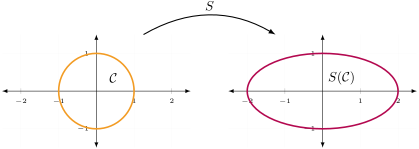
Recall the transformation \(S:\R^{2}\to\R^{2}\) defined by \(\mat{x\\y}\mapsto\mat{2x\\y}\text{.}\) If we had a bunch of vectors in the plane, applying \(S\) would stretch those vectors in the \(\xhat\) direction by a factor of \(2\text{.}\) For example, let \(\mathcal{C}\) be the circle of radius \(1\) centered at \(\vec 0\text{.}\) Applying \(S\) to all the vectors that make up \(\mathcal{C}\) produces an ellipse.
Figure9.1.1.
The operation of applying a transformation to a specific set of vectors and seeing what results is called taking the image of a set.
Definition9.1.2.Image of a Set.
Let \(L:\R^{n}\to \R^{m}\) be a transformation and let \(X\subseteq \R^{n}\) be a set. The image of the set \(X\) under \(L\), denoted \(L(X)\), is the set
\begin{equation*}
L(X)=\Set{\vec y\in \R^m \given \vec y=L(\vec x)\text{ for some }\vec x\in X}.
\end{equation*}
In plain language, the image of a set \(X\) under a transformation \(L\) is the set of all outputs of \(L\) when the inputs come from \(X\text{.}\)
If you think of sets in \(\R^{n}\) as black-and-white “pictures” (a point is black if it’s in the set and white if it’s not), then the image of a set under a transformation is the output after applying the transformation to the “picture”.
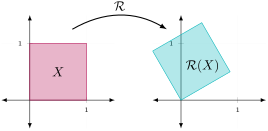
Images allow one to describe complicated geometric figures in terms of an original figure and a transformation. For example, let \(\mathcal{R}:\R^{2}\to\R^{2}\) be rotation counter clockwise by \(30^{\circ}\) and let \(X=\Set{x\xhat+y\yhat\given x,y\in[0,1]}\) be the filled-in unit square. Then, \(\mathcal{R}(X)\) is the filled-in unit square that meets the \(x\)-axis at an angle of \(30^{\circ}\text{.}\) Try describing that using set builder notation!
Figure9.1.3.
Section9.2Linear Transformations
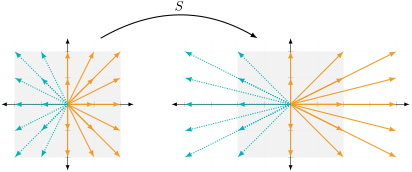
Linear algebra’s main focus is the study of a special category of transformations: the linear transformations. Linear transformations include rotations, dilations (stretches), shears, and more.
Figure9.2.1.
Linear transformations are an important type of transformation because (i) we have a complete theory of linear transformations (non-linear transformations are notoriously difficult to understand), and (ii) many non-linear transformations can be approximated by linear ones 1
Just like in one-variable calculus where if you zoom into a function at a point its graph looks like a line, if you zoom into a (non-linear) transformation at a point, it looks like a linear one.
. All this is to say that linear transformations are worthy of our study.
Without further ado, let’s define what it means for a transformation to be linear.
Definition9.2.2.Linear Transformation.
Let \(V\) and \(W\) be subspaces. A function \(T:V\to W\) is called a linear transformation if
for all vectors \(\vec u,\vec v\in V\) and all scalars \(\alpha\text{.}\)
In plain language, the transformation \(T\) is linear, or has the property of linearity, if it distributes over addition and scalar multiplication. In other words, \(T\)distributes over linear combinations.
Example9.2.3.
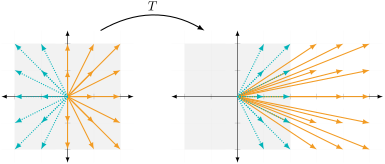
Let \(S:\R^{2}\to\R^{2}\) and \(T:\R^{2}\to\R^{2}\) be defined by
For each of \(S\) and \(T\text{,}\) determine whether the transformation is linear.
Solution.
Let \(\vec u=\mat{u_1\\u_2}\text{,}\)\(\vec v=\mat{v_1\\v_2}\) be vectors, and let \(\alpha\) be a scalar.
We first consider \(\mathcal{S}\text{.}\) We need to verify that \(\mathcal{S}(\vec u+\vec v)=\mathcal{S}(\vec u)+\mathcal{S}(\vec v)\) and \(\mathcal{S}(\alpha\vec u)=\alpha\mathcal{S}(\vec u)\text{.}\)
Computing, we see
\begin{equation*}
\mathcal{S}(\vec u +\vec v)=\mathcal{S}\left(\mat{u_1+v_1\\u_2+v_2}\right)=\matc{2u_1+2v_1\\u_2+v_2}=\mat{2u_1\\u_2}+\mat{2v_1\\v_2}=\mathcal{S}(\vec u) + \mathcal{S}(\vec v)
\end{equation*}
and so \(\mathcal{S}\) satisfies all the properties of a linear transformation.
Next we consider \(\mathcal{T}\text{.}\) Notice that \(\mathcal{T}(\vec u+\vec v)=\matc{u_1+v_1\\u_2+v_2+4}\) doesn’t look like \(\mathcal{T}(\vec u)+\mathcal{T}(\vec v)=\matc{u_1+v_1\\u_2+v_2+8}\text{.}\) Therefore, we will guess that \(\mathcal{T}\) is not linear and look for a counter example.
Using \(\xhat=\mat{1\\0}\) and \(\yhat=\mat{0\\1}\text{,}\) we see
Since at least one required property of a linear transformation is violated, \(\mathcal{T}\) cannot be a linear transformation.
Section9.3Function Notation vs. Linear Transformation Notation
Linear transformations are just special types of functions. In calculus, it is traditional to use lower case letters for a function and parenthesis “(” and “)” around the input to the function.
\begin{equation*}
\underbrace{f:\R\to\R}_{\text{a function named $f$}}\qquad \underbrace{f(x)}_{\text{$f$ evaluated at $x$}}
\end{equation*}
For (linear) transformations, it is traditional to use capital letters to describe the function/transformation and parenthesis around the input are optional.
\begin{equation*}
\underbrace{T:\R^n\to\R^m}_{\text{a transformation named $T$}}\qquad \underbrace{T(\vec x)}_{\text{$T$ evaluated at $\vec x$}}\qquad \underbrace{T\vec x}_{\text{also $T$ evaluated at $\vec x$}}
\end{equation*}
Since sets are also traditionally written using capital letters, sometimes a font variant is used to when writing the transformation or the set. For example, we might use a regular \(X\) to denote a set and a calligraphic \(\mathcal{T}\) to describe a transformation.
Another difference you might not be used to is that, in linear algebra, we make a careful distinction between a function and its output. Let \(f:\R\to\R\) be a function. In calculus, you might consider the phrases “the function \(f\)” and “the function \(f(x)\)” to both make sense. In linear algebra, the first phrase is valid and the second is not. By writing \(f(x)\text{,}\) we are indicating “the output of the function \(f\) when \(x\) is input”. So, properly we should say “the number\(f(x)\)”.
This distinction might seem pedantic now, but by keeping our functions as functions and our numbers/vectors as numbers/vectors, we can avoid some major confusion in the future.
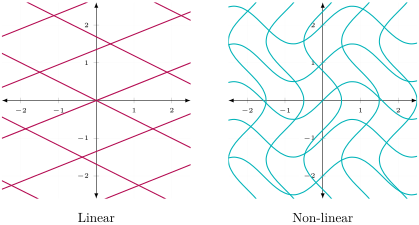
Section9.4The “look” of a Linear Transformation
Images under linear transformations have a certain look to them. Based just on the word linear you can probably guess which figure below represents the image of a grid under a linear transformation.
Figure9.4.1.
Let’s prove some basic facts about linear transformations.
Theorem9.4.2.
If \(T:\R^{n}\to\R^{m}\) is a linear transformation, then \(T(\vec 0)=\vec 0\).
Proof.
Suppose \(T:\R^{n}\to\R^{m}\) is a linear transformation and \(\vec v\in \R^{n}\text{.}\) We know that \(0\vec v=\vec 0\text{,}\) so by linearity we have
If \(T:\R^{n}\to\R^{m}\) is a linear transformation, then \(T\) takes lines to lines (or points).
Proof.
Suppose \(T:\R^{n}\to\R^{m}\) is a linear transformation and let \(\ell\subseteq\R^{n}\) be the line given in vector form by \(\vec x=t\vec d+\vec p\text{.}\) We want to prove that \(T(\ell)\text{,}\) the image of \(\ell\) under the transformation \(T\text{,}\) is a line or a point.
By definition, every point in \(\ell\) takes the form \(t\vec d+\vec p\) for some scalar \(t\text{.}\) Therefore, every point in \(T(\ell)\) takes the form \(T(t\vec d+\vec p)\) for some scalar \(t\text{.}\) But, \(T\) is a linear transformation, so
If \(T(\vec d)\neq \vec 0\text{,}\) then \(\vec x=tT(\vec d)+T(\vec p)\) describes a line in vector form and so \(T(\ell)\) is a line. If \(T(\vec d)=\vec 0\text{,}\) then \(T(\ell) = \Set{t\vec 0+T(\vec p)\given \text{$t$ is a scalar}}=\Set{T(\vec p)}\) is a point.
Theorem9.4.4.
If \(T:\R^{n}\to\R^{m}\) is a linear transformation, then \(T\) takes parallel lines to parallel lines (or points).
Proof.
Suppose \(T:\R^{n}\to\R^{m}\) is a linear transformation and let \(\ell_{1}\) and \(\ell_{2}\) be parallel lines. Then, we may describe \(\ell_{1}\) in vector form as \(\vec x=t\vec d+\vec p_{1}\) and we may describe \(\ell_{2}\) in vector form as \(\vec x=t\vec d+\vec p_{2}\text{.}\) Note that since the lines are parallel, the direction vectors are the same.
Now, \(T(\ell_{1})\) can be described in vector form by
Written this way and provided \(T(\ell_{1})\) and \(T(\ell_{2})\) are actually lines, we immediately see that \(T(\ell_{1})\) and \(T(\ell_{2})\) have the same direction vectors and hence are parallel.
If \(T(\ell_{1})\) is instead a point, then we must have \(T(\vec d)=\vec 0\text{,}\) and so \(T(\ell_{2})\) must also be a point.
Theorem9.4.5.
If \(T:\R^{n}\to\R^{m}\) is a linear transformation, then \(T\) takes subspaces to subspaces.
Proof.
Let \(T:\R^{n}\to\R^{m}\) be a linear transformation and let \(V\subseteq \R^{n}\) be a subspace. We need to show that \(T(V)\) satisfies the properties of a subspace.
Since \(V\) is non-empty, we know \(T(V)\) is non-empty.
Let \(\vec x,\vec y\in T(V)\text{.}\) By definition, there are vectors \(\vec u,\vec v\in V\) so that
Since \(V\) is a subspace, \(\alpha\vec u\in V\) and so \(\alpha\vec x=T(\alpha\vec u)\in T(V)\text{.}\)
Section9.5Linear Transformations and Proofs
When proving things in math, you have all of logic at your disposal, and that freedom can be combined with creativity to show some truly amazing things. But, for better or for worse, proving whether or not a transformation is linear usually doesn’t require substantial creativity.
Let \(T:\R^{n}\to\R^{n}\) be defined by \(T(\vec v)=2\vec v\text{.}\) To show that \(T\) is linear, we need to show that for all inputs \(\vec x\) and \(\vec y\) and for all scalars \(\alpha\) we have
But, there are an infinite number of choices for \(\vec x\text{,}\)\(\vec y\text{,}\) and \(\alpha\text{.}\) How can we argue about all of them at once?
Consider the following proof that \(T\) is linear.
Proof.
Let \(\vec x,\vec y\in \R^{n}\) and let \(\alpha\) be a scalar. By applying the definition of \(T\text{,}\) we see
Since \(T\) satisfies the two properties of a linear transformation, \(T\) is a linear transformation.
This proof starts out with “let \(\vec x,\vec y\in \R^{n}\) and let \(\alpha\) be a scalar”. In what follows, the only properties of \(\vec x\) and \(\vec y\) we use come from the fact that they’re in \(\R^{n}\) (the domain of \(T\)) and the only fact about \(\alpha\) we use is that it’s a scalar. Because of this, \(\vec x\text{,}\) and \(\vec y\) are considered arbitrary vectors and \(\alpha\) is an arbitrary scalar. Put another way, the argument that followed would work for every single pair of vectors \(\vec x,\vec y\in \R^{n}\) and for every scalar \(\alpha\text{.}\) Thus, by fixing arbitrary vectors at the start of our proof, we are (i) able to argue about all vectors at once while (ii) having named vectors that we can actually use in equations.
Takeaway9.5.1.
Starting a linearity proof with “let \(\vec x,\vec y\in \R^{n}\) and let \(\alpha\) be a scalar” allows you to argue about all vectors and scalars simultaneously.
The proof given above is very typical, and almost every proof of the linearity of a function \(T:\R^{n}\to\R^{m}\) will look something like
Proof.
Let \(\vec x,\vec y\in \R^{n}\) and let \(\alpha\) be a scalar. By applying the definition of \(T\text{,}\) we see
\begin{equation*}
T(\vec x+\vec y)=\text{application(s) of the definition}= T(\vec x)+T(\vec y).
\end{equation*}
Similarly,
\begin{equation*}
T(\alpha\vec x) = \text{application(s) of the definition}=\alpha T(\vec x).
\end{equation*}
Since \(T\) satisfies the two properties of a linear transformation, \(T\) is a linear transformation.
This isn’t to say that proving whether or not a transformation is linear is easy, but all the cleverness and insight required appears in the “application(s) of the definition” parts.
What about showing a transformation is not linear? Here we don’t need to show something true for all vectors and all scalars. We only need to show something is false for one pair of vectors or one pair of a vector and a scalar.
When proving a transformation is not linear, we can pick one of the properties of linearity (distribution over vector addition or distribution over scalar multiplication) and a single example where that property fails 1
It’s often tempting to argue that the properties of linearity fail for all inputs, but this is a dangerous path! For instance, if \(T(\vec 0)=\vec 0\text{,}\) then \(T(\vec a)=T(\vec a+\vec 0)=T(\vec a)+T(\vec 0)=T(\vec a)\)regardless of whether \(T\) is linear or not.
.
Example9.5.2.
Let \(T:\R^{n}\to\R^{n}\) be defined by \(T(\vec x)=\vec x+\xhat\text{.}\) Show that \(T\) is not linear.
Solution.
Proof.
We will show that \(T\) does not distribute with respect to scalar multiplication.
Therefore, \(T\) cannot be a linear transformation.
Section9.6Matrix Transformations
We already know two ways to interpret matrix multiplication—linear combinations of the columns and dot products with the rows—and we’re about to have a third.
Let \(M=\mat{1&2\\-1&1}\text{.}\) For a vector \(\vec v\in \R^{2}\text{,}\)\(M\vec v\) is another vector in \(\R^{2}\text{.}\) In this way, we can think of multiplication by \(M\) as a transformation on \(\R^{2}\text{.}\) Define
Because \(T\) is defined by a matrix, we call \(T\) a matrix transformation. It turns out all matrix transformations are linear transformations and most linear transformations are matrix transformations 1
If you believe in the axiom of choice and you allow infinitely sized matrices, every linear transformation can be expressed as a matrix transformation.
.
When it comes to specifying linear transformations, matrices are heroes, providing a compact notation (just like they did for systems of linear equations). For example, we could say, “The linear transformation \(T:\R^{2}\to\R^{2}\) that doubles the \(x\)-coordinate and triples the \(y\)-coordinate”, or we could say, “The matrix transformation given by \(\mat{2&0\\0&3}\)”.
When talking about matrices and linear transformations, we must keep in mind that they are not the same thing. A matrix is a box of numbers and has no meaning until we give it meaning. A linear transformation is a function that inputs vectors and outputs vectors. We can specify a linear transformation using a matrix, but a matrix by itself is not a linear transformation 2
Consider the function defined by \(f(x)=2x\text{.}\) You would never say that the function \(f\) is \(2\text{!}\)
.
Takeaway9.6.1.
Matrices and linear transformations are closely related, but they aren’t the same thing.
So what are some correct ways to specify a linear transformation using a matrix? For a matrix \(M\text{,}\) the following are correct.
The transformation \(T\) defined by \(T(\vec x)=M\vec x\text{.}\)
The transformation given by multiplication by \(M\text{.}\)
The transformation induced by \(M\text{.}\)
The matrix transformation given by \(M\text{.}\)
The linear transformation whose matrix is \(M\text{.}\)
Section9.7Finding a Matrix for a Linear Transformation
Every linear transformation from \(\R^{n}\) to \(\R^{m}\) has a matrix, and we can use basic algebra to find an appropriate matrix.
Let \(T:\R^{n}\to\R^{m}\) be a linear transformation. Since \(T\) inputs vectors with \(n\) coordinates and outputs vectors with \(m\) coordinates, we know any matrix for \(T\) must be \(m\times n\text{.}\) The process of finding a matrix for \(T\) can now be summarized as follows: (i) create an \(m\times n\) matrix of variables, (ii) use known input-output pairs for \(T\) to set up a system of equations involving the unknown variables, (iii) solve for the variables.
Example9.7.1.
Let \(\mathcal{T}:\R^{2}\to\R^{2}\) be defined by \(\mathcal{T}\mat{x\\y}=\matc{2x+y\\x}\text{.}\) Find a matrix, \(M\text{,}\) for \(\mathcal{T}\text{.}\)
Solution.
Because \(\mathcal{T}\) is a transformation for \(\R^{2}\to\R^{2}\text{,}\)\(M\) will be a \(2\times 2\) matrix. Let
For each transformation listed below, prove whether or not it is a linear transformation.
\(\mathcal{A}:\R^{2}\to\R^{2}\) defined by \(\mathcal{A}\mat{x\\y}=\mat{-x\\y}\text{.}\)
\(\mathcal{B}:\R^{2}\to\R^{2}\) defined by \(\mathcal{B}\mat{x\\y}=\matc{-x-1\\y}\text{.}\)
\(\Ident:\R^{2}\to\R^{2}\text{,}\) the function that leaves its input unchanged.
\(\mathcal{C}:\R^{2}\to\R^{2}\text{,}\) where \(\mathcal{C}\) sends all vectors above the \(x\)-axis to \(\vec 0\) and all vectors on or below the \(x\)-axis to \(-\yhat\text{.}\)
Solution.
Yes. \(\mathcal{A}\) is a linear transformation. Let \(\vec{u}= \mat{u_1\\u_2}\) and \(\vec{v}= \mat{v_1 \\ v_2}\) be two vectors and \(\alpha\) be a scalar. \(\mathcal{A}(\vec{u}+ \vec{v}) = \mathcal{A}\mat{u_1 + v_1 \\ u_2 + v_2}= \mat{-u_1 - v_1 \\ u_2 + v_2 }= \mat{-u_1 \\ u_2 }+ \mat{ - v_1 \\ v_2 }= \mathcal{A}\mat{u_1\\u_2}+ \mathcal{A}\mat{v_1 \\ v_2}= \mathcal{A}(\vec{u}) +\mathcal{A}(\vec{v})\) and \(\mathcal{A}(\alpha \vec{u}) = \mathcal{A}\mat{\alpha u_1 \\ \alpha u_2}= \mat{ - \alpha u_1 \\ \alpha u_2}= \alpha \mat{ - u_1 \\u_2}= \alpha \mathcal{A}\mat{ u_1 \\u_2}= \alpha \mathcal{A}(\vec{u})\) So \(\mathcal{A}\) satisfies all the properties of a linear transformation.
Yes. Let \(\vec{u}= \mat{u_1\\u_2}\) and \(\vec{v}= \mat{v_1 \\ v_2}\) be two vectors and \(\alpha\) be a scalar. \(\mathbf{id}(\vec{u}+\vec{v}) = \mathbf{id}\mat{u_1 + v_1 \\ u_2 + v_2}= \mat{u_1 + v_1 \\ u_2 + v_2 }= \mat{u_1 \\ u_2 }+ \mat{ v_1 \\ v_2 }= \mathbf{id}\mat{u_1\\u_2}+ \mathbf{id}\mat{v_1 \\ v_2}= \mathbf{id}(\vec{u}) +\mathbf{id}(\vec{v})\) and \(\mathbf{id}(\alpha \vec{u}) =\mathbf{id}\mat{\alpha u_1 \\ \alpha u_2}= \mat{ \alpha u_1 \\ \alpha u_2}= \alpha \mat{ u_1 \\u_2}= \alpha \; \mathbf{id}\mat{ u_1 \\u_2}= \alpha \; \mathbf{id}(\vec{u})\) So \(\mathbf{id}\) satisfies all the properties of a linear transformation.
No. As \(\vec{0}\) is on the \(x\)-axis, \(\mathcal{C}(\vec{0}) = - \vec{e}_{2}\neq \vec{0}\) .
2.
Draw the image of the unit circle under each transformation listed in 9.8.1.
Solution.
Notice \(\mathcal{A}\) is just reflection about \(y\)-axis. If you reflect all points on the circle about the \(y\)-axis you get back the unit circle.
\(\mathcal{B}\mat{x\\y}= \matc{-x-1\\y}= \mat{-x\\y}+ \mat{-1\\0}\text{.}\) So the transformation \(\mathcal{B}\) reflects over the \(y\)-axis and then translates. We already know the first operation keeps the circle as it is. So the final image is just a translated circle, that is unit circle with center at (-1,0).
\(\Ident\) leaves all points unchanged. So the image of the unit circle under \(\Ident\) is still the unit circle.
The unit circle under \(\mathcal{C}\) is the set \(\Set{(0,0), (0,-1)}\text{.}\)
3.
Let \(M=\mat{1&-2&3\\-4&5&-6}\) and let \(T_{M}\) be the corresponding matrix transformation.
Determine the domain and codomain of \(T_{M}\text{.}\)
Find the image of the standard basis vectors of the domain under \(T_{M}\text{.}\)
Solution.
Recall that an \(m \times n\) matrix represents a transformation from \(\R^{n}\rightarrow \R^{m}\text{.}\) The given matrix \(M\) is \(2 \times 3\text{,}\) so \(T_{M}: \R^{3}\rightarrow \R^{2}\text{.}\) Thus the domain of \(T_{M}\) is \(\R^{3}\) and codomain is \(\R^{2}.\)
Find a matrix for each transformation below, or explain why no such matrix exists.
\(\mathcal{S}:\R^{2}\to\R^{2}\text{,}\) where \(\mathcal{S}\) is the transformation that doubles every vector.
\(\mathcal{R}:\R^{2}\to\R^{2}\text{,}\) where \(\mathcal{R}\) is rotation clockwise by \(135^{\circ}\text{.}\)
\(\mathcal{T}:\R^{2}\to\R^{2}\text{,}\) where \(\mathcal{T}\) translates every vector by \(3\xhat\text{.}\)
\(\mathcal{P}:\R^{2}\to\R^{2}\text{,}\) where \(\mathcal{P}\) is projection onto the \(y\)-axis.
\(\mathcal{F}:\R^{2}\to\R^{2}\text{,}\) where \(\mathcal{F}\) is reflection over the line \(y=x\text{.}\)
Solution.
\(\displaystyle \mat{2 & 0 \\ 0& 2}\)
To determine the image of \(\vec{e}_{1}, \vec{e}_{2}\text{,}\) we use trigonometry. Note \(\mathcal{R}\mat{1\\0}= \mat{- \cos (45^{o}) \\ - \sin (45^{o})}= \mat{- 1/ \sqrt{2} \\ - 1/ \sqrt{2}}\) and \(\mathcal{R}\mat{0\\1}= \mat{ \cos (45^{o}) \\ - \sin (45^{o})}= \mat{ 1/ \sqrt{2} \\ -1/ \sqrt{2}}\text{.}\) To see this draw pictures, draw angles and remember that \(\vec{e}_{1}\) and \(\vec{e}_{2}\) are unit vectors. Thus the matrix of \(\mathcal{R}\) is \(\mat{- \frac{1 }{\sqrt{2}} & \frac{1 }{\sqrt{2}}\\ - \frac{1}{\sqrt{2}} & -\frac{1}{\sqrt{2}}}\text{.}\)
No such matrix exists as this is not a linear transformation.
\(\displaystyle \mat{0 & 0 \\ 0 & 1}\)
\(\displaystyle \mat{0 & 1 \\ 1 & 0}\)
5.
Let \(S:\R^{n}\to\R^{m}\) and \(T:\R^{n}\to\R^{m}\) be linear transformations, and define the transformation \(R:\R^{n}\to\R^{m}\) by \(R (\vec x)=S(\vec x)+T(\vec x)\text{.}\) Show that \(R\) is also linear.
Solution.
Let \(\vec{u}\) and \(\vec{v}\) be two vectors in \(\R^{n}\) and \(c\) be a scalar. Then we have, \(R(\vec{u}+ \vec{v}) = S(\vec{u}+ \vec{v}) + T(\vec{u}+ \vec{v})\text{.}\) Since given that both \(S, T\) are linear transformations, we get \(S(\vec{u}+ \vec{v}) + T(\vec{u}+ \vec{v}) = S(\vec{u})+ S(\vec{v}) + T(\vec{u})+T (\vec{v}) = (S(\vec{u})+ T(\vec{u})) + (S(\vec{v})+ T (\vec{v})) = R(\vec{u})+ R(\vec{v})\text{.}\) Hence we have, \(R(\vec{u}+ \vec{v})=R(\vec{u})+ R(\vec{v})\text{.}\) Similarly, \(R(c \vec{u})= S(c \vec{u})+T(c \vec{u}) = cS( \vec{u})+cT( \vec{u}) = cR( \vec{u})\text{.}\) Thus \(R\) is also linear.
6.
For a fixed vector \(\vec a\in\R^{3}\text{,}\) define the function \(D_{\vec a}\) by \(D_{\vec a}(\vec x) = \vec a\cdot\vec x\text{.}\)
Identify the domain and codomain of \(D_{\vec a}\text{.}\)
Show that when \(\vec a=\xhat\text{,}\) then \(D_{\vec a}\) is a linear transformation.
Is \(D_{\vec a}\) a linear transformation for all \(\vec a\text{?}\) Prove your claim.
Find a matrix for \(D_{\vec a}\) or explain why no such matrix exists.
Solution.
Since dot product is only defined for vectors in the same space, if \(\vec{a}\in \R^{3}\text{,}\)\(\vec{x}\) must also be in \(\R^{3}\text{.}\) So the domain of \(D_{\vec{a}}\) is \(\R^{3}.\)
Let \(\vec{u}= \mat{u_1\\u_2\\u_3}\) and \(\vec{v}= \mat{v_1 \\ v_2\\v_3}\) be two vectors and \(\alpha\) be a scalar. Then
Yes, \(D_{\vec{a}}\) is a linear transformation for all vectors \(\vec{a}\text{.}\) The properties of linear transformation can be proved from properties of dot product. Let \(\vec{u}\) and \(\vec{v}\) be two vectors and \(\alpha\) be a scalar. Then \(D_{\vec{a}}(\vec{u}+ \vec{v})= \vec{a}\cdot (\vec{u}+ \vec{v}) = \vec{a}\cdot \vec{u}+ \vec{a}\cdot \vec{v}= D_{\vec{a}}(\vec{u}) + D_{\vec{a}}(\vec{v})\) and
\(D_{\vec{a}}: \R^{3}\rightarrow \R\text{.}\) Thus the matrix, say \(M_{D}\text{,}\) will be \(1 \times 3\text{.}\) If \(\vec{a}= \mat{a_1\\a_2\\ a_3}\) Then, \(M_{D}= \mat{a_1 & a_2 & a_3}\)
7.
Let \(T:\R^{2}\to\R^{2}\) be a transformation with the property that \(T(V)\) is a subspace whenever \(V\) is a subspace. Is this enough information to conclude that \(T\) is a linear transformation? Justify your answer.
Solution.
No. Here is a (counter) example of a transformation which is not linear : \(T : \R^{2}\rightarrow \R^{2}\) is such that \(T\) keeps the coordinates of the points on \(x\)-axis unchanged and sends every other point to \(\vec{0}\text{.}\) That is, \(T\) is given by \(T \mat{x\\y}= \mat{0\\0}\) if \(y\neq 0\text{,}\) and \(T\mat{x\\0}= \mat{x\\0}\text{.}\)
Then \(T\) satisfies the given condition : \(T(\R^{2})\) is the \(x\)-axis which is a subspace. \(T(\vec{0})= \vec{0}\Rightarrow \{T(\vec{0}) \} = \{\vec{0}\}\text{,}\) so \(T\) sends the zero subspace to the zero subspace. Other subspaces of \(\R^{2}\) are lines through the origin. \(T\) sends all such lines except for the \(x\)-axis to the subspace \(\{ \vec{0}\}\text{.}\)\(T\) sends the subspace \(x\)-axis to \(x\)-axis. Thus \(T(V)\) is a subspace whenever \(V\) is a subspace. But clearly \(T\) is not linear. Take for example : \(T \mat{1\\1}= \mat{0\\0}\) by construction. But \(\mat{1\\1}= \mat{1\\0}+ \mat{0\\1}\) and \(\left( T\mat{1\\0}+ T \mat{0\\1}\right)= \mat{1\\0}+ \mat{0\\0}= \mat{1\\0}\neq T \mat{1\\1}\)
8.
For each statement below, determine whether it is true or false. Justify your answer.
Every transformation from \(\R^{n}\) to \(\R^{m}\) can be represented by a matrix.
The image of a subspace under a linear transformation is not a subspace.
A transformation that takes every vector in the domain to \(\vec 0\) is not linear.
Every matrix is a linear transformation.
Parallel lines stay parallel under a linear transformation.
Solution.
False. Take \(T : \R^{2}\rightarrow \R^{2}\) given by \(T \mat{x\\y}= \mat{x-1\\0}\text{.}\) If there were a matrix \(\mat{a & b \\ c& d}\) representing this transformation, then consider \(T\mat{1\\0}\) and \(T\mat{2\\0}\text{.}\)\(T\mat{1\\0}=\mat{a & b \\ c& d}\mat{1\\0}=\mat{0\\0}\) which implies that \(a=0, c=0\text{.}\) But \(T\mat{2\\0}=\mat{a & b \\ c& d}\mat{2\\0}= \mat{1\\0}\) which implies \(a= \tfrac{1}{2},c=0\) — a contradiction! So no such matrix exists. The correct statement is the following: Every “linear” transformation from \(\mathbb{R}^{n}\) to \(\mathbb{R}^{m}\) can be represented by a matrix.
False. This follows directly from the theorem given in this chapter that if \(T : \mathbb{R}^{n}\rightarrow \mathbb{R}^{m}\) is a linear transformation, then \(T\) takes subspaces to subspaces.
False. The transformation is linear. Check the properties. Note: this transformation is sometimes called “the zero transformation.’
False. A matrix is just a box of numbers, it has no meaning unless we give it meaning. We can specify a linear transformation by using a matrix, but a matrix by itself is not a linear transformation.
False. There is a theorem in this module which explains this point. Suppose \(T:\mathbb{R}^{2}\rightarrow \mathbb{R}^{2}\) is the tranformation which takes all vectors to the zero vector, \(\ell_{1}\) is given by the equation \(y=x+1\) and \(\ell_{2}\) is given by the equation \(y=x+2\text{.}\) Then \(T\) is a linear transformation but \(T(\ell_{1})=T(\ell_{2})=\Set{(0,0)}\text{.}\) Hence it doesn’t make sense to say \(\ell_{1}\) and \(\ell_{2}\) are parallel under \(T\text{.}\)
9.
Let \(\mathcal{T}:\R^{2}\to\R^{2}\) be the transformation that doubles the length of its input. The following statements about \(\mathcal{T}\) are either incorrect or incomplete. Fix each statement so that it is correct and complete.
\(\mathcal{T}=\mat{2&0\\0&2}\text{.}\)
Since \(\mathcal{T}\vec x=2\vec x\) for every \(\vec x\text{,}\) we can say \(\mathcal{T}=2\text{.}\)
\(\mathcal{T}\) is a linear transformation because \(2(\vec x+\vec y)=2\vec x+2\vec y\text{.}\)
Solution.
\(\mathcal{T}\) can be defined by \(\mathcal{T}\vec x=\mat{2&0\\0&2}\vec x\text{.}\)
Since \(\mathcal{T}\vec x=2\vec x\) for every \(\vec x\in\R^{2}\) we can define \(\mathcal{T}\) as the function which multiplies its input by the scalar two.
\(\mathcal{T}\) is a linear transformation because \(\mathcal{T}(\vec x+\vec y)=2(\vec x+\vec y)=2\vec x+2\vec y= \mathcal{T}\vec x+\mathcal{T}\vec y\) and \(\mathcal{T}(\alpha\vec x)=2\alpha\vec x=\alpha2\vec x=\alpha\mathcal{T}\vec x\) for all \(\vec x,\vec y\in \R^{2}\) and all scalars \(\alpha\text{.}\)