Geometric and algebraic definitions of the dot product.
How dot products relate to the length of a vector and the angle between two vectors.
The normal form of lines, planes, and hyperplanes.
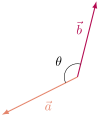
Let \(\vec a\) and \(\vec b\) be vectors rooted at the same point and let \(\theta\) denote the smaller of the two angles between them (so \(0\leq \theta \leq \pi\)). The dot product of \(\vec a\) and \(\vec b\) is defined to be
and so \(\theta=\arccos\Big(\tfrac{-3}{2\sqrt{21}}\Big)\text{.}\)
The dot product has several interesting properties. Since the angle between \(\vec a\) and itself is \(0\text{,}\) the geometric definition of the dot product tells us
and so dot products can be used to compute the length of vectors 1
Oftentimes in non-geometric settings, the dot product between two vectors is defined first and then the length of \(\vec a\) is actually defined to be \(\sqrt{\vec a\cdot \vec a}\text{.}\)
.
From the algebraic definition of the dot product, we can deduce several distributive laws. Namely, for any vectors \(\vec a\text{,}\)\(\vec b\text{,}\) and \(\vec c\) and any scalar \(k\) we have
\begin{equation*}
(k\vec a)\cdot \vec b = k(\vec a\cdot \vec b)=\vec a\cdot (k\vec b)
\end{equation*}
and
\begin{equation*}
\vec a\cdot \vec b=\vec b\cdot \vec a.
\end{equation*}
Section4.1Orthogonality
Recall that for vectors \(\vec a\) and \(\vec b\text{,}\) the relationship \(\vec a\cdot \vec b=0\) can hold for two reasons: (i) either \(\vec a=\vec 0\text{,}\)\(\vec b=\vec 0\text{,}\) or both or (ii) \(\vec a\) and \(\vec b\) meet at \(90^{\circ}\text{.}\) Thus, the dot product can be used to tell if two vectors are perpendicular. There is some strangeness with the zero vector here, but it turns out this strangeness simplifies our lives mathematically.
Definition4.1.1.Orthogonal.
Two vectors \(\vec u\) and \(\vec v\) are orthogonal to each other if \(\vec u\cdot \vec v=0\text{.}\) The word orthogonal is synonymous with the word perpendicular.
The definition of orthogonal encapsulates both the idea of two vectors forming a right angle and the idea of one of them being \(\vec 0\text{.}\)
Before we continue, let’s pin down exactly what we mean by the direction of a vector. There are many ways we could define this term, but we’ll go with the following.
Definition4.1.2.Direction.
The vector \(\vec u\) points in the direction of the vector \(\vec v\) if \(\vec u=k\vec v\) for some scalar \(k\text{.}\) The vector \(\vec u\) points in the positive direction of \(\vec v\) if \(\vec u=k\vec v\) for some positive scalar \(k\text{.}\)
The vector \(2\xhat\) points in the direction of \(\xhat\) since \(\frac{1}{2}(2\xhat)=\xhat\text{.}\) Since \(\frac{1}{2}>0\text{,}\)\(2\xhat\) also points in the positive direction of \(\xhat\text{.}\) In contrast, \(-\xhat\) points in the direction \(\xhat\) but not the positive direction of \(\xhat\text{.}\)
When it comes to the relationship between two vectors, there are two extremes: they point in the same direction, or they are orthogonal. The dot product can be used to tell you which of these cases you’re in, and more than that, it can tell you to what extent one vector points in the direction of another (even if they don’t point in the same direction).
Example4.1.3.
Let \(\vec a=\mat{1\\2}\text{,}\)\(\vec b=\mat{3\\3}\text{,}\)\(\vec c=\mat{2\\1}\text{,}\) and \(\vec v=\mat{3\\4}\text{.}\) Which vector out of \(\vec a\text{,}\)\(\vec b\text{,}\) and \(\vec c\) has a direction closest to the direction of \(\vec v\text{?}\)
Solution.
We would like to know when \(\theta\text{,}\) the angle between a pair of the given vectors, is smallest. This is equivalent to finding when \(\cos\theta\) is closest to 1 (since \(\cos0=1\)). By equating the geometric and algebraic definitions of the dot product, we know
Let \(\alpha\text{,}\)\(\beta\text{,}\) and \(\gamma\) be the angles between the vector \(\vec v\) and the vectors \(\vec a\text{,}\)\(\vec b\text{,}\)\(\vec c\text{,}\) respectively. Computing, we find
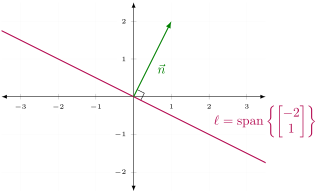
and so \(v_{1}=-2v_{2}\text{.}\) In other words, \(\vec v\) is orthogonal to \(\vec n\) exactly when \(\vec v\in\Span\Set{\mat{-2\\1}}\text{.}\) What have we learned? The set of all vectors orthogonal to \(\vec n\) forms a line \(\ell=\Span\Set{\mat{-2\\1}}\text{.}\) In this case, we call \(\vec n\) a normal vector for \(\ell\text{.}\)
Figure4.2.1.
Definition4.2.2.Normal Vector.
A normal vector to a line (or plane or hyperplane) is a non-zero vector that is orthogonal to all direction vectors for the line (or plane or hyperplane).
In \(\R^{2}\text{,}\) normal vectors provide yet another way to describe lines, including lines which don’t pass through the origin.
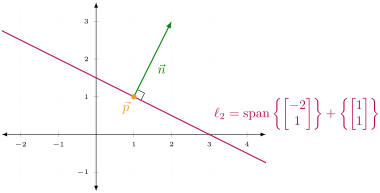
Let \(\vec n=\mat{1\\2}\) as before, and fix \(\vec p=\mat{1\\1}\text{.}\) If we draw the set of all vectors orthogonal to \(\vec n\) but root all the vectors at \(\vec p\), again we get a line, but this time the line passes through \(\vec p\text{.}\)
Figure4.2.3.
In fact, the line we get is \(\ell_{2}=\Span\Set{\mat{-2\\1}}+\Set{\mat{1\\1}}=\ell+\Set{\vec p}\text{,}\) which is just \(\ell\) (the parallel line through the origin) translated by \(\vec p\text{.}\)
Let’s relate this to dot products and normal vectors. By definition, for every \(\vec v\in \ell\text{,}\) we have \(\vec n\cdot \vec v=0\text{.}\) Since \(\ell_{2}\) is a translate of \(\ell\) by \(\vec p\text{,}\) we deduce the relationship that for every \(\vec v\in \ell_{2}\text{,}\)
When a line is expressed as above, we say it is expressed in normal form.
Definition4.2.4.Normal Form of a Line.
A line \(\ell\subseteq \R^{2}\) is expressed in normal form if there exist vectors \(\vec n\neq \vec 0\) and \(\vec p\) so that \(\ell\) is the solution set to the equation
The equation \(\vec n\cdot (\vec x-\vec p)=0\) is called the normal form of \(\ell\).
Though the definition doesn’t explicitly state it, if a line \(\ell\in \R^{2}\) is expressed in normal form as \(\vec n\cdot (\vec x-\vec p)=0\text{,}\) then \(\vec n\)is necessarily a normal vector for \(\ell\). (Think about what the solution set to \(\vec n\cdot (\vec x-\vec p)=0\) would be if \(\vec n\) happened to be \(\vec 0\text{!}\))
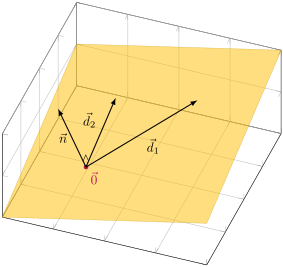
What about in \(\R^{3}\text{?}\) Fix a non-zero vector \(\vec n\in\R^{3}\) and let \(\mathcal{Q}\subseteq\R^{3}\) be the set of vectors orthogonal to \(\vec n\text{.}\)\(\mathcal{Q}\) is a plane through the origin, and again, we call \(\vec n\) a normal vector of the plane \(\mathcal{Q}\text{.}\)
Figure4.2.5.
In a similar way to the line, \(\mathcal{Q}\) is the set of solutions to \(\vec n\cdot \vec x=0\text{.}\) And, for any \(\vec p\in\R^{3}\text{,}\) the translated plane \(\mathcal{Q}+\Set{\vec p}\) is the solution set to
Thus, we see planes in \(\R^{3}\) have a normal form just like lines in \(\R^{2}\) do.
Example4.2.6.
Find vector form and normal form of the plane \(\mathcal{P}\) passing through the points \(A=(1,0,0)\text{,}\)\(B=(0,1,0)\) and \(C=(0,0,1)\text{.}\)
Solution.
To find vector form of \(\mathcal{P}\text{,}\) we need a point on the plane and two direction vectors. We have three points on the plane, so we can obtain two direction vectors by subtracting these points in different ways. Let
To write \(\mathcal{P}\) in normal form, we need to find a normal vector for \(\mathcal{P}\text{.}\) By inspection, we see that \(\vec n=(1,1,1)\) is a normal vector to \(\mathcal{P}\text{.}\) (If we weren’t so insightful, we could also solve the system \(\vec n\cdot \vec d_{1}=0\) and \(\vec n\cdot\vec d_{2}=0\) to find a normal vector.) Now, we may express \(\mathcal{P}\) in normal form as
In \(\R^{2}\text{,}\) only lines have a normal form, and in \(\R^{3}\) only planes have a normal form. In general, we call objects in \(\R^{n}\) which have a normal form hyperplanes.
Definition4.2.7.Hyperplane.
The set \(X\subseteq \R^{n}\) is called a hyperplane if there exists \(\vec n\neq \vec 0\) and \(\vec p\) so that \(X\) is the set of solutions to the equation
Hyperplanes always have dimension one less than the space they’re contained in. So, hyperplanes in \(\R^{2}\) are (one-dimensional) lines, hyperplanes in \(\R^{3}\) are regular (two-dimensional) planes, and hyperplanes in \(\R^{4}\) are (three-dimensional) volumes.
Section4.3Hyperplanes and Linear Equations
Suppose \(\vec n,\vec p\in \R^{3}\) and \(\vec n\neq \vec 0\text{.}\) Then, solutions to
Equation (4.3.1) is sometimes called scalar form of a plane. For us, it will not be important to distinguish between scalar and normal form, but what is important is that we can use the row reduction algorithm to write the complete solution to (4.3.1), and this complete solution will necessarily be written in vector form.
Example4.3.1.
Let \(\mathcal{Q}\subseteq \R^{3}\) be the plane passing through \(\vec p\) and with normal vector \(\vec n\) where
Rearranging, we see \(\mathcal{Q}\) is the set of all solutions to
\begin{equation*}
x+y+z=2.
\end{equation*}
Using the row reduction algorithm to write the complete solution 1
In some sense, this is overkill because the equation corresponds to the augmented matrix \(\mat{1&1&1&\!\!\!\!|\!\!\!\!&2}\text{,}\) which is already row reduced.
For each pair of vectors listed below, determine if the angle between the vectors is greater than, less than, or equal to \(90^{\circ}\text{.}\)
\(\mat{1\\0}\) and \(\mat{-3\\4}\)
\(\mat{1\\0\\1}\) and \(\mat{-5\\4\\-3}\)
\(\mat{1\\2\\3}\) and \(\mat{-1\\-1\\2}\)
Solution.
Greater than \(90^{\circ}\)
Greater than \(90^{\circ}\)
Less than \(90^{\circ}\)
4.
For each vector, find two unit vectors orthogonal to it.
\(\displaystyle \mat{0\\1}\)
\(\displaystyle \mat{1\\2}\)
\(\displaystyle \mat{1\\3\\5}\)
\(\displaystyle \mat{-13\\-4\\5}\)
\(\displaystyle \mat{0\\1\\1\\\frac{1}{2}}\)
Solution.
\(\mat{1\\0}\) and \(\mat{-1\\0}\)
\(\dfrac{1}{\sqrt{5}}\mat{2\\-1}\) and \(\dfrac{1}{\sqrt{5}}\mat{-2\\1}\)
\(\dfrac{1}{\sqrt{10}}\mat{3\\-1\\0}\) and \(\dfrac{1}{\sqrt{26}}\mat{5\\0\\-1}\)
\(\dfrac{1}{\sqrt{6}}\mat{1\\-2\\1}\) and \(\dfrac{1}{\sqrt{41}}\mat{0\\5\\4}\)
\(\mat{1\\0\\0\\0}\) and \(\dfrac{1}{\sqrt{2}}\mat{0\\1\\-1\\0}\)
5.
Compute the distance between the following pairs of vectors.
\(\mat{-1\\1}\) and \(\mat{-1\\-4}\)
\(\mat{2\\-6\\5}\) and \(\mat{-4\\7\\-3}\)
\(\mat{1\\1\\1}\) and \(\mat{-1\\-1\\-1}\)
\(\mat{0\\0\\0\\0\\0}\) and \(\mat{1\\1\\1\\1\\1}\)
Solution.
\(\displaystyle 5\)
\(\displaystyle \sqrt{269}\)
\(\displaystyle 2\sqrt{3}\)
\(\displaystyle \sqrt{5}\)
6.
Which vector out of \(\mat{1\\0}\text{,}\)\(\mat{0\\1}\text{,}\) and \(\mat{4\\1}\) has a direction closest to that of \(\mat{3\\5}\text{?}\)
Which vector out of \(\mat{2\\3\\4}\text{,}\)\(\mat{1\\-1\\-1}\text{,}\) and \(\mat{-3\\0\\1}\) has a direction closest to that of \(\mat{1\\0\\1}\text{?}\)
Solution.
\(\displaystyle \mat{0\\1}\)
\(\displaystyle \mat{2\\3\\4}\)
7.
For each plane specified, express the plane in both vector form and normal form.
The plane \(\mathcal{P}\subseteq\R^{3}\) passing through the points \(A=(2,0,0)\text{,}\)\(B=(0,3,0)\) and \(C=(0,0,-1)\text{.}\)
The plane \(\mathcal{Q}\subseteq\R^{3}\) passing through the points \(D=(1,1,1)\text{,}\)\(E=(1,-2,1)\) and \(F=(0,12,0)\text{.}\)
Solution.
\(\vec x=t\mat{2\\0\\1}+s\mat{0\\3\\1}+\mat{2\\0\\0}\) and \(\mat{3\\2\\-6}\cdot\left(\vec x-\mat{2\\0\\0}\right)=0\)
Let \(\mathcal{A}\subseteq \R^{3}\) be the plane passing through \(\mat{0\\1\\1}\) and with normal vector \(\mat{-1\\-1\\-1}\text{.}\) Write \(\mathcal{A}\) in vector form.
Let \(\mathcal{B}\subseteq \R^{3}\) be the plane passing through \(\mat{1\\2\\3}\) and with normal vector \(\mat{1\\-1\\0}\text{.}\) Write \(\mathcal{B}\) in vector form.
Solution.
\(\displaystyle \vec x = t\mat{-1\\1\\0}+s\mat{0\\1\\-1}+ \mat{0\\1\\1}\)
\(\displaystyle \vec x = t\mat{1\\1\\0}+s\mat{0\\0\\1}+\mat{1\\2\\3}\)
9.
In this problem we will prove some algebraic properties of the dot product.
In the general case, the left side will be the sum of \((x_{i}+y_{i})z_{i}\) and the right side will be the sum of \(x_{i}z_{i}+y_{i}z_{i}\text{.}\) Since these two terms are always equal, the two sums are equal. So yes, the same conclusion hold true in all dimensions.
In the general case, the left side will be the sum of \(kx_{i}y_{i}\) and the right side will be the product of \(k\) and the sum of \(x_{i}y_{i}\text{.}\) Distributing the product of \(k\) onto the sum, we get that these two results are equal. So yes, the same conclusion hold true in all dimensions.
The dot product distributes onto sums, just like the typical multiplication of real numbers.
10.
Let \(\vec u, \vec v \in \R^{n}\text{.}\) In this problem, we will prove \(\Abs{\vec u \cdot \vec v}\leq \Norm{\vec u}\Norm{\vec v}\text{.}\) This is called the Cauchy-Schwarz inequality.
Assuming the geometric definition \(\vec u \cdot \vec v = \Norm{\vec u}\Norm{\vec v}\cos \theta\) where \(\theta\) is the angle between \(\vec u\) and \(\vec v\text{,}\) prove the Cauchy-Schwarz inequality.
The Cauchy-Schwartz inequality can also be proved using only the algebraic definition of the dot product. Keep in mind the following facts which come from the algebraic definition: Let \(\vec x, \vec y, \vec z \in \R^{n}, k \in \R\text{.}\) (i) \(\Norm{\vec x}= \sqrt{\vec x \cdot \vec x}\text{;}\) (ii) \((\vec x + \vec y) \cdot \vec z = \vec x \cdot \vec z + \vec y \cdot \vec z\text{;}\) (iii) \((k\vec x) \cdot \vec y = k(\vec x \cdot \vec y)\text{;}\) (iv) \(\vec x \cdot \vec y = \vec y \cdot \vec x\text{.}\)
Explain why the result is immediate if one (or both) of \(\vec u, \vec v\) is the zero vector.
Assume \(\vec u, \vec v\) are non-zero vectors. Consider the function \(f: \R \to \R\) where \(f(t) = \Norm{t\vec u - \vec v}^{2}\text{.}\) Convince yourself that \(f(t) \geq 0\) for all \(t \in \R\text{.}\)
Simplify \(f(t)\) into a quadratic formula so that \(f(t) = at^{2}- bt + c\) by determining its coefficients \(a, b, c\) in terms of \(\vec u, \vec v\text{.}\)
Prove \(\Abs{\vec u \cdot \vec v}\leq \Norm{\vec u}\Norm{\vec v}\text{,}\) the Cauchy-Schwarz inequality. Hint: Consider \(f(\frac{b}{2a})\text{.}\)
Prove \(\Abs{\vec u \cdot \vec v}= \Norm{\vec u}\Norm{\vec v}\) if the vectors \(\vec u, \vec v\) are scalar multiples of each other.
11.
Let \(\vec u, \vec v \in \R^{n}\text{.}\) In this problem, we will prove \(\Norm{\vec u + \vec v}\leq \Norm{\vec u}+ \Norm{\vec v}\text{.}\) This is called the Triangle Inequality.
Pick your favorite vectors \(\vec u, \vec v\) and draw a picture of \(\vec u, \vec v\text{,}\) and \(\vec u + \vec v\text{.}\) Root your vectors so that they form the edges of a triangle. Can you explain why the Triangle Inequality is true?
Express \(\Norm{\vec u + \vec v}\) in terms of dot products and square roots.
Prove the Triangle Inequality.
12.
Let \(\mathcal{A}= \{\vec v_{1},\dots , \vec v_{k}\} \subset \R^{n}\text{.}\)\(A\) is a set of mutually orthogonal vectors if for all \(i \neq j\text{,}\) we have \(\vec v_{i}\cdot \vec v_{j}= 0\text{.}\)
Suppose \(\mathcal{A}\) is a set of mutually orthogonal vectors. Is \(\mathcal{A}\) a linearly independent set? Why or Why not?
Suppose \(\mathcal{A}\) is a set of mutually orthogonal and non-zero vectors. Is \(\mathcal{A}\) a linearly independent set? Why or Why not?
Solution.
\(\mathcal{A}\) is linearly dependent if \(\vec{0}\in\mathcal{A}\text{,}\) and is linearly independent otherwise.
for some \(\alpha_{1}, \dots, \alpha_{n}\in\R\text{.}\)
For any \(i=1, \dots, n\text{,}\) take the dot product of \(\vec{v}_{i}\) with both sides of this equation, we have \(\alpha_{i}\Norm{\vec{v_i}}^{2}=0\text{.}\) Since \(\vec{v}_{i}\) is a non-zero vector, this implies that \(\alpha_{i}=0\text{.}\)
Then, \(\alpha_{1}=\cdots=\alpha_{n}=0\) and therefore \(\mathcal{A}\) is linearly independent.