The definition of vectors and how they relate to points.
Column vector notation and how to represent vectors in drawings.
How to compute linear combinations of vectors and use systems of linear equations to answer questions about linear combinations of vectors.
Section1.1Sets
Modern mathematics makes heavy use of sets. A set is an unordered collection of distinct objects. We won’t try and pin it down more than this—our intuition about collections of objects will suffice 1
When you pursue more rigorous math, you rely on definitions to get yourself out of philosophical jams. For instance, with our definition of set, consider “the set of all sets that don’t contain themselves”. Such a set cannot exist! This is called Russel’s Paradox, and shows that if we start talking about sets of sets, we may need more than intuition.
. We write a set with curly-braces \(\{\) and \(\}\) and list the objects inside. For instance
\begin{equation*}
\Set{1,2,3}.
\end{equation*}
This would be read aloud as “the set containing the elements \(1\text{,}\)\(2\text{,}\) and \(3\)”. Things in a set are called elements, and the symbol \(\in\) is used to specify that something is an element of a set. In contrast, \(\notin\) is used to specify something is not an element of a set. For example,
It is tradition to use capital letters to name sets. So we might say \(A=\{6,7,12\}\) or \(X=\{7\}\text{.}\) However there are some special sets which already have names/symbols associated with them. The empty set is the set containing no elements and is written \(\emptyset\) or \(\Set{}\text{.}\) Note that \(\Set{\emptyset}\) is not the empty set—it is the set containing the empty set! It is also traditional to call elements of a set points regardless of whether you consider them “point-like”.
Section1.2Operations on Sets
If the set \(A\) contains all the elements that the set \(B\) does, we call \(B\) a subset of \(A\text{.}\) Conversely, we call \(A\) a superset of \(B\text{.}\)
Definition1.2.1.Subset & Superset.
The set \(B\) is a subset of the set \(A\text{,}\) written \(B\subseteq A\), if for all \(b\in B\) we also have \(b\in A\text{.}\) In this case, \(A\) is called a superset of \(B\text{.}\) 1
Some mathematicians use the symbol \(\subset\) instead of \(\subseteq\text{.}\)
Some simple examples are \(\Set{1,2,3}\subseteq \Set{1,2,3,4}\) and \(\Set{1,2,3}\subseteq\Set{1,2,3}\text{.}\) There’s something funny about that last example, though. Those two sets are not only subsets/supersets of each other, they’re equal. As surprising as it seems, we actually need to define what it means for two sets to be equal.
Definition1.2.2.Set Equality.
The sets \(A\) and \(B\) are equal, written \(A=B\text{,}\) if \(A\subseteq B\) and \(B\subseteq A\text{.}\)
Having a definition of equality to lean on will help us when we need to prove things about sets.
Example1.2.3.
Let \(A\) be the set of numbers that can be expressed as \(2n\) for some whole number \(n\text{,}\) and let \(B\) be the set of numbers that can be expressed as \(m+1\) where \(m\) is an odd whole number. We will show \(A=B\text{.}\)
Solution.
First, let us show \(A\subseteq B\text{.}\) If \(x\in A\text{,}\) then \(x=2n\) for some whole number \(n\text{.}\) Therefore
where \(m=2(n-1)+1\) is, by definition, an odd number. Thus \(x\in B\text{,}\) which proves \(A\subseteq B\text{.}\)
Now we will show \(B\subseteq A\text{.}\) Let \(x\in B\text{.}\) By definition, \(x=m+1\) for some odd \(m\text{.}\) By the definition of oddness, \(m=2k+1\) for some whole number \(k\text{.}\) Thus
where \(n=k+1\text{,}\) and so \(x\in A\text{.}\) Since \(A\subseteq B\) and \(B\subseteq A\text{,}\) by definition \(A=B\text{.}\)
Section1.3Set-builder Notation
Specifying sets by listing all their elements can be a hassle, and if there are an infinite number of elements, it’s impossible! Fortunately, set-builder notation solves these problems. If \(X\) is a set, we can define a subset
which is read “\(Y\) is the set of \(a\) in \(X\)such that some rule involving \(a\) is true.” If \(X\) is intuitive, we may omit it and simply write \(Y=\Set{a\given\text{some rule involving }a}\) 1
If you want to get technical, to make this notation unambiguous, you define a universe of discourse. That is, a set \(\mathcal{U}\) containing every object you might want to talk about. Then \(\Set{a\given\text{some rule involving }a}\) is short for \(\Set{a\in\mathcal{U}\given\text{some rule involving }a}\text{.}\)
. You may equivalently use “\(|\)” instead of “\(:\)”, writing \(Y=\{a\,|\,\text{some rule involving }a\}\text{.}\)
There are also some common operations we can do with two sets.
Definition1.3.1.Unions & Intersections.
Let \(X\) and \(Y\) be sets. The union of \(X\) and \(Y\) and the intersection of \(X\) and \(Y\) are defined as follows.
(union)
\(X\cup Y = \Set{ a \given a\in X\text{ or }a\in Y}\text{.}\)
(intersection)
\(X\cap Y = \Set{ a \given a\in X\text{ and }a\in Y}\text{.}\)
For example, if \(A=\Set{1,2,3}\) and \(B=\Set{-1,0,1,2}\text{,}\) then \(A\cap B=\Set{1,2}\) and \(A\cup B= \Set{-1,0,1,2,3}\text{.}\) Set unions and intersections are associative, which means it doesn’t matter how you apply parentheses to an expression involving just unions or just intersections. For example \((A\cup B)\cup C=A\cup(B\cup C)\text{,}\) which means we can give an unambiguous meaning to an expression like \(A\cup B\cup C\) (just put the parentheses wherever you like). But watch out, \((A\cup B)\cap C\) means something different than \(A\cup(B\cap C)\text{!}\)
A scalar number (also referred to as a scalar or just an ordinary number) models a relationship between quantities. For example, a recipe might call for six times as much flour as sugar. In contrast, a vector models a relationship between points. For example, the store might be 2km East and 4km North from your house. In this way, a vector may be thought of as a displacement with a direction and a magnitude 1
Though in this book we will treat vectors as geometric objects relating to Euclidean space, they are much more general. For instance, someone’s internet browsing habits could be described by a vector—the topics they find most interesting might be the “direction” and the amount of time they browse might be the “magnitude.”
.
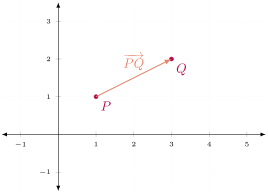
Given points \(P=(1,1)\) and \(Q=(3,2)\text{,}\) we specify the displacement from \(P\) to \(Q\) as a vector \(\overrightarrow{PQ}\) whose magnitude is \(\sqrt{5}\) (as given by the Pythagorean theorem) and whose direction is specified by a directed line segment from \(P\) to \(Q\text{.}\)
Figure1.4.1.
Section1.5Vector Notation
There are many ways to represent vector quantities in writing. If we have two points, \(P\) and \(Q\text{,}\) we write \(\overrightarrow{PQ}\) to represent the vector from \(P\) to \(Q\text{.}\) Absent points, a bold-faced letter (like a) or an arrow over a letter (like \(\vec a\)) are the most common vector notations. In this text, we will use \(\vec a\) to represent a vector. The notation \(\norm{\vec a}\) represents the magnitude of the vector \(\vec a\text{,}\) which is sometimes called the norm or length of \(\vec a\text{.}\)
Graphically, we may represent vectors as directed line segments (a line segment with an arrow at one end), however we must take care to distinguish between the picture we draw and the “true” vector. For example, directed line segments always start somewhere, but a vector models a displacement and has no sense of “origin”.
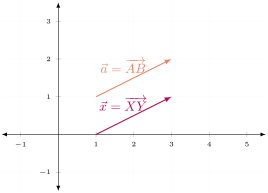
Consider the following: for the points \(A=(1,1)\text{,}\)\(B=(3,2)\text{,}\)\(X=(1,0)\text{,}\) and \(Y=(3,1)\text{,}\) define the vectors \(\vec a = \overrightarrow{AB}\) and \(\vec x=\overrightarrow{XY}\text{.}\)
Figure1.5.1.
Are these the same or different vectors? As directed line segments, they are different because they are at different locations in space. However, both \(\vec a\) and \(\vec x\) have the same magnitude and direction. Thus, \(\vec a=\vec x\) despite the fact that \(A\neq X\) 1
Some theories use rooted vectors instead of vectors as the fundamental object of study. A rooted vector represents a magnitude, direction, and a starting point. And, as rooted vectors, \(\vec a\neq \vec x\) (from the example above). But for us, vectors will always be unrooted, even though our graphical representations of vectors might appear rooted.
.
Takeaway1.5.2.
A vector is not the same as a line segment and a vector by itself has no “origin”.
Section1.6Vectors and Points
The distinction between vectors and points is sometimes nebulous because the two are so closely related. A point in Euclidean space specifies an absolute position whereas a vector specifies a displacement (i.e., a magnitude and direction). However, given a point \(P\text{,}\) one associates \(P\) with the vector \(\vec p=\overrightarrow{OP}\text{,}\) where \(O\) is the origin. Similarly, we associate the vector \(\vec v\) with the point \(V\) so that \(\overrightarrow{OV}=\vec v\text{.}\) Thus, we have a way to unambiguously go back and forth between vectors and points 1
Mathematically, we say there is an isomorphism between vectors and points (once an origin is fixed, of course!).
. As such, we will treat vectors and points interchangeably.
Takeaway1.6.1.
Vectors and points can and will be treated interchangeably.
Section1.7Vector Arithmetic
Vectors provide a natural way to give directions. For example, suppose \(\xhat\) points one kilometer eastwards and \(\yhat\) points one kilometer northwards. Now, if you were standing at the origin and wanted to move to a location 3 kilometers east and 2 kilometers north, you might say: “Walk 3 times the length of \(\xhat\) in the \(\xhat\) direction and 2 times the length of \(\yhat\) in the \(\yhat\) direction.” Mathematically, we express this as
\begin{equation*}
3\xhat+2\yhat.
\end{equation*}
Of course, we’ve incidentally described a new vector. Let \(P\) be the point at 3-east and 2-north. Then
and we have the relationship \(\vec r=10\yhat\text{.}\) Our notation here is very suggestive. Indeed, if we could make sense of “\(\alpha\vec v\)” (scalar multiplication) and “\(\vec v+\vec w\)” (vector addition) for any scalar \(\alpha\) and any vectors \(\vec v\) and \(\vec w\text{,}\) we could do algebra with vectors.
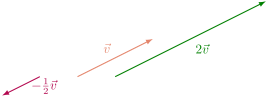
We will define scalar multiplication intuitively: For a vector \(\vec v\) and a scalar \(\alpha>0\text{,}\) the vector \(\vec w=\alpha\vec v\) is the vector pointing in the same direction as \(\vec v\) but with length scaled by \(\alpha\text{.}\) That is, \(\norm{\vec w}=\alpha\norm{\vec v}\text{.}\) Similarly, \(-\vec v\) is the vector of the same length as \(\vec v\) but pointing in the exact opposite direction.
Figure1.7.1.
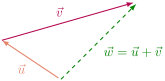
For two vectors \(\vec u\) and \(\vec v\text{,}\) the sum \(\vec w=\vec u+\vec v\) represents the displacement vector created by first displacing along \(\vec u\) and then displacing along \(\vec v\text{.}\)
Figure1.7.2.
Takeaway1.7.3.
You add vectors tip to tail and you scale vectors by changing their length.
Now, there is one snag. What should \(\vec v+(-\vec v)\) be? Well, first we displace along \(\vec v\) and then we displace in the exact opposite direction by the same amount. So, we have gone nowhere. This corresponds to a displacement with zero magnitude. But, what direction did we displace? Here we make a philosophical stand.
Definition1.7.4.Zero Vector.
The zero vector, notated as \(\vec 0\), is the vector with no magnitude.
We will be pragmatic about the direction of the zero vector and say, the zero vector does not have a well-defined direction 1
In the mathematically precise definition of vector, the idea of “magnitude” and “direction” are dropped. Instead, a set of vectors is defined to be a set over which you can reasonably define addition and scalar multiplication.
. That means sometimes we consider the zero vector to point in every direction and sometimes we consider it to point in no directions. It depends on our mood—but we must never talk about the direction of the zero vector, since it’s not defined.
Formalizing, for vectors \(\vec u\text{,}\)\(\vec v\text{,}\)\(\vec w\text{,}\) and scalars \(\alpha\) and \(\beta\text{,}\) the following laws are always satisfied:
Indeed, if we intuitively think about vectors in flat (Euclidean) space, all of these properties are satisfied 2
If we deviate from flat space, some of these rules are no longer respected. Consider moving 100 kilometers north then 100 kilometers east on a sphere. Is this the same as moving 100 kilometers east and then 100 kilometers north?
. From now on, these properties of vector operations will be considered the laws (or axioms) of vector arithmetic.
We group scalar multiplication and vector addition under one name: linear combinations.
Definition1.7.5.Linear Combination.
A linear combination of the vectors \(\vec v_{1},\vec v_{2},\ldots,\vec v_{n}\) is a vector
\begin{equation*}
\vec w = \alpha_{1}\vec v_{1}+\alpha_{2}\vec v_{2}+\cdots+\alpha_{n}\vec v_{n}.
\end{equation*}
The scalars \(\alpha_{1},\alpha_{2},\ldots,\alpha_{n}\) are called the coefficients of the linear combination.
Section1.8Coordinates and the Standard Basis
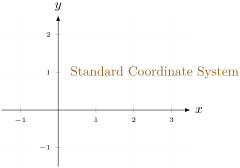
Consider the standard, flat, Euclidean plane (which is notated by \(\R^{2}\)). A coordinate system for \(\R^{2}\) is a way to assign a unique pair of numbers to every point in \(\R^{2}\text{.}\) Though there are infinitely many coordinate systems we could choose for the plane, there is one standard one: the \(xy\)-coordinate system depicted below (which you’re already familiar with).
Figure1.8.1.
Figure1.8.2.
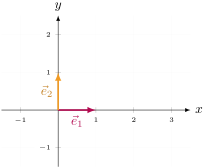
In conjunction with the standard coordinate system, there are also standard basis vectors. The vector \(\xhat\) always points one unit in the direction of the positive \(x\)-axis and \(\yhat\) always points one unit in the direction of the positive \(y\)-axis.
Using the standard basis, we can represent every point (or vector) in the plane as a linear combination. If the point \(P\) has \(xy\)-coordinates \((\alpha,\beta)\text{,}\) then \(\overrightarrow{OP}=\alpha\xhat+\beta\yhat\text{.}\) Not only that, but this is the only way to represent the vector \(\overrightarrow{OP}\) as a linear combination of \(\xhat\) and \(\yhat\text{.}\)
Takeaway1.8.3.
Every vector in \(\R^{2}\) can be written uniquely as a linear combination of the standard basis vectors.
For a vector \(\vec w=\alpha\xhat+\beta\yhat\text{,}\) we call the pair \((\alpha,\beta)\) the standard coordinates of the vector \(\vec w\text{.}\) There are many equivalent notations used to represent a vector in coordinates.
\((\alpha,\beta)\)
parentheses
\(\langle \alpha,\beta\rangle\)
angle brackets
\(\mat{\alpha&\beta}\)
square brackets in a row (a row matrix/row vector)
\(\mat{\alpha\\\beta}\)
square brackets in a column (a column matrix/column vector)
Coordinates and vectors go hand in hand, and we will often write
Using these rules, otherwise complicated questions about vectors can be reduced to simple algebra questions 1
So simple, that computers are able to answer billions of such questions a second as you play your favorite video game!
.
Example1.9.1.
Let \(\vec x=\xhat-\yhat\text{,}\)\(\vec y=3\xhat-\yhat\text{,}\) and \(\vec r=2\xhat+2\yhat\text{.}\) Is \(\vec r\) a linear combination of \(\vec x\) and \(\vec y\text{?}\)
Solution.
By definition, \(\vec r\) is a linear combination of \(\vec x\) and \(\vec y\) if there exist scalars \(a\) and \(b\) such that
\begin{equation*}
\vec r= a\vec x+b\vec y.
\end{equation*}
Rewriting everything in coordinates, we see this is equivalent to the equation
has a solution. After solving, we find \(a=-4\) and \(b=2\) is the only solution. Thus, \(\vec r\) is a linear combination of \(\vec x\) and \(\vec y\text{.}\) More specifically,
\begin{equation*}
\vec r = -4\vec x+2\vec y.
\end{equation*}
Section1.10Higher Dimensions
We coordinatize three dimensional space (notated by \(\R^{3}\)) by constructing \(x\text{,}\)\(y\text{,}\) and \(z\) axes. Again, \(\R^{3}\) has standard basis vectors \(\xhat\text{,}\)\(\yhat\text{,}\) and \(\zhat\) which each point one unit along the \(x\text{,}\)\(y\text{,}\) and \(z\) axes, respectively.
Since we live in three dimensional space, its study has a long history, and many notations for the standard basis of three dimensional space are in use. This text will use \(\xhat\text{,}\)\(\yhat\text{,}\)\(\zhat\text{,}\) but other common notations include:
\(\hat{\mathbf{x}}\)
\(\hat{\mathbf{y}}\)
\(\hat{\mathbf{z}}\)
\(\hat{\imath}\)
\(\hat{\jmath}\)
\(\hat{k}\)
\(\mathbf{i}\)
\(\mathbf{j}\)
\(\mathbf{k}\)
\(\vec e_{1}\)
\(\vec e_{2}\)
\(\vec e_{3}\)
Beyond three dimensions, drawing pictures becomes hard, but we can still use vectors. We use \(\R^{n}\) to notate \(n\)-dimensional Euclidean space. The standard basis for \(\R^{n}\) is \(\sbasis{1}\text{,}\)\(\sbasis{2}\text{,}\) …, \(\sbasis{n}\text{.}\) Again, every vector in \(\R^{n}\) can be written uniquely as a linear combination of the standard basis, and a coordinate representation of a vector in \(\R^{n}\) is a list of \(n\) scalars.
Example1.10.1.
Let \(\vec x,\vec y\in\R^{3}\) be given by \(\vec x=2\xhat-\zhat\) and \(\vec y=6\yhat+3\zhat\text{.}\) Compute \(\vec z=\vec x+2\vec y\text{.}\)
Decide if the vector is in the set. If it is, what value of the parameters produce that vector?
\(\mat{5\\-5}\) and the set
\begin{equation*}
\Set{\vec{v}\in\R^2 \given \vec{v}=k\mat{1\\-1} \text{ for some } k\in\R}
\end{equation*}
\(\mat{-1\\2\\1}\) and the set
\begin{equation*}
\Set{\vec{v}\in\R^3 \given \vec{v}=i\mat{-2\\1\\0}+j\mat{3\\0\\1} \text{ for some } i,j\in\R}
\end{equation*}
\(\mat{3\\-1}\) and the set
\begin{equation*}
\Set{\vec{v}\in\R^2 \given \vec{v}=k\mat{-6\\2} \text{ for some } k\in\R}
\end{equation*}
\(\mat{5\\4}\) and the set
\begin{equation*}
\Set{\vec{v}\in\R^2 \given \vec{v}=j\mat{5\\-4} \text{ for some } j\in\R}
\end{equation*}
\(\mat{2\\1\\-1}\) and the set
\begin{equation*}
\Set{\vec{v}\in\R^3 \given \vec{v}=r\mat{1\\-1\\3}+\mat{0\\3\\-7} \text{ for some } r\in\R}
\end{equation*}
\(\mat{1\\0\\1}\) and the set
\begin{equation*}
\Set{\vec{v}\in\R^3 \given \vec{v}=j\mat{2\\0\\1}+k\mat{-3\\-1\\1} \text{ for some } j,k\in\R}
\end{equation*}
Solution.
Yes, take \(k=5\text{.}\)
Yes, take \(i=2,j=1\text{.}\)
Yes, take \(k=-\frac{1}{2}\text{.}\)
No.
Yes, take \(r=2\text{.}\)
No.
4.
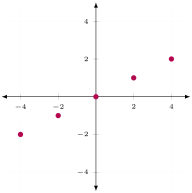
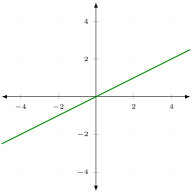
Draw the following subsets of \(\R^{2}\) and then determine which are equal or subsets of each other.
\(\displaystyle A=\Set{\vec v\in\R^2\given \vec v=n\mat{2\\1}\text{ for some integer }n\in\Z}\)
\(\displaystyle B=\Set{\vec v\in\R^2\given \vec v=t\mat{4\\2}\text{ for some }t\in\R}\)
\(\displaystyle C=\Set{\vec v\in\R^2\given \vec v=n\mat{4\\2}\text{ for some integer }n\in\Z}\)
\(\displaystyle D=\Set{\vec v\in\R^2\given \vec v=t\mat{2\\1}\text{ for some }t\in\R}\)
Solution.
Figure1.11.1.
Figure1.11.2.
Figure1.11.3.
The set \(D\) and \(B\) are equal.
We have \(C\subseteq A\text{,}\)\(C\subseteq B\text{,}\)\(C\subseteq D\text{,}\)\(A\subseteq B\text{,}\)\(A\subseteq D\text{,}\) and \(B=D\text{.}\)
5.
Let \(\vec a=\mat{1\\2}\text{,}\)\(\vec b=\mat{2\\4}\text{,}\)\(\vec c=\xhat+3\yhat\text{,}\) and \(\vec d=\vec a+\vec c\text{.}\)
Is \(\xhat\) a linear combination of \(\vec a\) and \(\vec b\text{?}\)
Is \(\vec d\) a linear combination of \(\vec a\) and \(\vec b\text{?}\)
Is \(\vec p=\mat{1\\1}\) a linear combination of \(\vec a\) and \(\vec c\text{?}\)
Is \(\vec q=\mat{-3\\3}\) a linear combination of \(\vec a\text{,}\)\(\vec b\text{,}\)\(\vec c\text{,}\) and \(\vec d\text{?}\)
Solution.
No.
No.
Yes.
Yes.
6.
Use set-builder notation to describe the following sets.
The set of vectors in \(\R^{2}\) whose coordinates are rational numbers.
The set of vectors in \(\R^{2}\) whose coordinates are irrational numbers.
Let \(P(\vec x) = -\vec x\text{.}\) The set \(\Set{P(\vec e_{1}), P(\vec e_{2})}\text{.}\)
Solution.
\(\displaystyle \Set{\vec{v}\in\R^2 \given \vec{v}=\mat{\alpha\\\beta} \text{ for some } \alpha,\beta\in\Q}\)
\(\displaystyle \Set{\vec{v}\in\R^2 \given \vec{v}=\mat{\alpha\\\beta} \text{ for some } \alpha,\beta\in\R\setminus\Q}\)
\(\displaystyle \Set{\vec{v}\in\R^2 \given \vec{v}=-\vec{e}_1 \text{ or } \vec{v}=-\vec{e}_2}\)
7.
Which of the following statements are true about the set listed below? Justify your answers.
\(\mathcal{Y}\text{,}\) the \(y\)-axis in \(\R^{3}\text{.}\)
\(\mathcal{Y}\) is a finite set.
Let
\begin{equation*}
\mathcal{A}= \Set{\vec a \in \R^3 \given \vec a = \beta \vec v \text{ for some } \vec v \in \mathcal{Y}, \beta \in \R},
\end{equation*}
then \(\mathcal{A}\subseteq \mathcal{Y}\text{.}\)
For all vectors \(\vec v \in \mathcal{Y}\text{,}\) we have \(\vec v \neq \vec 0\text{.}\)
For some vectors \(\vec v \in \mathcal{Y}\text{,}\) we have \(\vec v \neq \vec 0\text{.}\)
For all vectors \(\vec v \in \mathcal{Y}\text{,}\) there exists a vector \(\vec x \in \mathcal{Y}\) such that \(\vec x + \vec v = \vec e_{2}\text{.}\)
There exists a vector \(\vec x \in \mathcal{Y}\) such that for all vectors \(\vec v \in \mathcal{Y}\text{,}\) we have \(\vec x + \vec v = \vec e_{2}\text{.}\)
\(\mathcal{S}\text{,}\) the set of vectors in \(\R^{3}\) whose coordinates are \(\pm3\text{.}\)
\(\mathcal{S}\) is a finite set.
Let
\begin{equation*}
\mathcal{A}= \Set{\vec a \in \R^3 \given \vec a = \beta \vec v \text{ for some } \vec v \in \mathcal{S}, \beta \in \R },
\end{equation*}
then \(\mathcal{A}\subseteq \mathcal{S}\text{.}\)
For all vectors \(\vec v \in \mathcal{S}\text{,}\) we have \(\vec v \neq \vec 0\text{.}\)
For some vectors \(\vec v \in \mathcal{S}\text{,}\) we have \(\vec v \neq \vec 0\text{.}\)
For all vectors \(\vec v \in \mathcal{S}\text{,}\) there exists a vector \(\vec x \in \mathcal{S}\) such that \(\vec x + \vec v = \vec 0\text{.}\)
There exists a vector \(\vec x \in \mathcal{S}\) such that for all vectors \(\vec v \in \mathcal{S}\text{,}\) we have \(\vec x + \vec v = \vec 0\text{.}\)
Solution.
False.
True.
False.
True.
True.
False.
True.
False.
True.
True.
True.
False.
8.
For each of the following statements, determine whether it is correct or not. If it is, prove it. Otherwise, give a counterexample.
If \(A \subseteq B\text{,}\) then \(A \cap B = A\text{.}\)
If \(B \subseteq A\text{,}\) then \(A \cap B = A\text{.}\)
If \(A \subseteq B\text{,}\) then \(A \cap B \neq B\text{.}\)
If \(B \subseteq A\text{,}\) then \(A \cap B \neq B\text{.}\)
If \(C \subseteq A \cap B\text{,}\) then \(C \subseteq A\text{.}\)
If \(C \subseteq A \cup B\text{,}\) then \(C \subseteq A\text{.}\)
If \(C \subseteq A \cup B\) and \(C \subseteq B\text{,}\) then \(A \cap B \subseteq C\text{.}\)