How to draw a set of vectors making an appropriate choice of when to use line segments and when to use dots to represent vectors.
The vector form of lines and planes, including how to determine the intersection of lines and planes in vector form.
Restricted linear combinations and how to use them to represent common geometric objects (like line segments or polygons).
With a handle on vectors, we can now use them to describe some common geometric objects: lines and planes.
Section2.1Lines
Consider for a moment the line \(\ell\) through the points \(P\) and \(Q\text{.}\) When \(P,Q\in\R^{2}\text{,}\) we can describe \(\ell\) with an equation of the form \(y=mx+b\) (provided it isn’t a vertical line), but if \(P,Q\in\R^{3}\text{,}\) it’s much harder to describe \(\ell\) with an equation. We can solve this problem by using vectors.
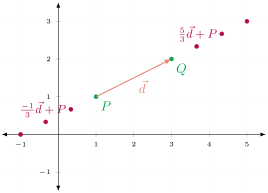
Let \(\vec d=\overrightarrow{PQ}\) and consider the set of points (or vectors) \(\vec x\) that can be expressed as
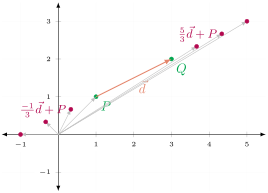
for \(t\in \R\text{.}\) Geometrically, this is the set of all points we get by starting at \(P\) and displacing by some multiple of \(\vec d\text{.}\) This is a line!
Figure2.1.1.
Figure2.1.2.
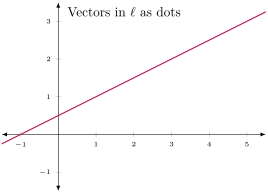
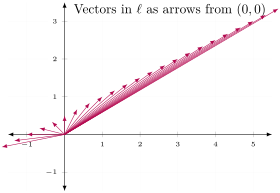
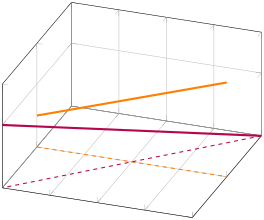
We simultaneously interpret this line as a set of points (the points that make up the line) and as a set of vectors rooted at the origin (the vectors pointing from the origin to the line). Note that sometimes we draw vectors as directed line segments. Other times, we draw each vector by marking only its ending point because drawing each vector as a line segment would make it hard to see what is going on.
Which picture below do you think best represents \(\ell\text{?}\)
Figure2.1.3.
Figure2.1.4.
Takeaway2.1.5.
When drawing a picture depicting several vectors, make an appropriate choice (arrows, dots, or a mix) so that the picture is clear.
The line \(\ell\) described above can be written in set-builder notation as:
\begin{equation*}
\ell=\Set{\vec x\given \vec x=t\vec d+P\text{ for some }t\in \R}.
\end{equation*}
Notice that in set-builder notation, we write “for some \(t\in \R\text{.}\)” Make sure you understand why replacing “for some \(t\in\R\)” with “for all \(t\in \R\)” would be incorrect.
Writing lines with set-builder notation all the time can be overkill, so we will allow ourselves to describe lines in a shorthand called vector form 1
\(y=mx+b\) form of a line is also shorthand. The line \(\ell\) described by the equation \(y=mx+b\) is actually the set \(\Set{(x,y)\in\R^2\given y=mx+b}\text{.}\)
.
Definition2.1.6.Vector Form of a Line.
Let \(\ell\) be a line and let \(\vec d\) and \(\vec p\) be vectors. If \(\ell=\Set{\vec x\given \vec x= t\vec d+\vec p\text{ for some } t\in\R }\text{,}\) we say the vector equation
\begin{equation*}
\vec x=t\vec d+\vec p
\end{equation*}
is \(\ell\) expressed in vector form. The vector \(\vec d\) is called a direction vector for \(\ell\text{.}\)
We can also use coordinates when writing a line in vector form. For example,
corresponds to the line passing through \(\mat{p_1\\p_2}\) with \(\mat{d_1\\d_2}\) as a direction vector.
The “\(t\)” that appears in a vector form is called the parameter variable, and for this reason, some textbooks use the term parametric form in place of “vector form”.
Writing a line in vector form requires only a point on the line and a direction for the line 2
Notice that a direction vector for a line \(\ell\) is different than a vector in a line \(\ell\text{.}\)
, which makes converting from another form into vector form straightforward.
Example2.1.7.
Find vector form of the line \(\ell\subseteq\R^{2}\) with equation \(y=2x+3\text{.}\)
Solution.
First, we find two points on \(\ell\text{.}\) By guess-and-check, we see \(P=(0,3)\) and \(Q=(1,5)\) are on \(\ell\text{.}\) Thus, a direction vector for \(\ell\) is given by
\begin{equation*}
\vec d = \mat{1\\5}-\mat{0\\3}=\mat{1\\2}.
\end{equation*}
It’s important to note that when we write a line in vector form, it is a specific shorthand notation. If we augment the notation, we no longer have written a line in “vector form”.
Example2.1.8.
Let \(\ell\) be a line, let \(\vec d\) be a direction vector for \(\ell\text{,}\) and let \(\vec p\in \ell\) be a point on \(\ell\text{.}\) Writing
\begin{equation*}
\vec x=t\vec d+\vec p
\end{equation*}
or
\begin{equation*}
\vec x=t\vec d+\vec p\quad\text{ where }\quad t\in \R
\end{equation*}
specifies \(\ell\) in vector form; both are shorthands for \(\Set{\vec x\given \vec x=t\vec d+\vec p\text{ for some }t\in \R}\text{.}\) But,
\begin{equation*}
\vec x=t\vec d+\vec p\quad\text{ for some }\quad t\in \R
\end{equation*}
and
\begin{equation*}
\vec x=t\vec d+\vec p\quad\text{ for all }\quad t\in \R
\end{equation*}
are logical statements about the vectors \(\vec x\text{,}\)\(\vec d\text{,}\) and \(\vec p\text{.}\) These statements are either true or false; they do not specify \(\ell\) in vector form.
Solution.
Similarly, the statement
\begin{equation*}
\ell = t\vec d+\vec p
\end{equation*}
is mathematically nonsensical and does not specify \(\ell\) in vector form. (On the left is a set and on the right is a vector!)
Takeaway2.1.9.
Vector form is a specific shorthand for a set. If “extra” words or symbols are added to the vector form, it stops being a shorthand.
But, why is vector form useful? For starters, every line can be expressed in vector form (you cannot write a vertical line in \(y=mx+b\) form, and in \(\R^{3}\text{,}\) you would need two linear equations to represent a line). But, the most useful thing about expressing a line in vector form is that you can easily generate points on that line.
Suppose \(\ell\) can be represented in vector form as \(\vec x=t\vec d+\vec p\text{.}\) Then, for every \(t\in \R\text{,}\) the vector \(t\vec d +\vec p\in\ell\text{.}\) Not only that, but as \(t\) ranges over \(\R\text{,}\) all points on \(\ell\) are “traced out”. Thus, we can find points on \(\ell\) without having to “solve” any equations.
The downside to using vector form is that it is not unique. There are multiple direction vectors and multiple points for every line. Thus, merely by looking at the vector equation for two lines, it can be hard to tell if they’re equal.
all represent the same line. In the second equation, the direction vector is parallel but scaled, and in the third equation, a different point on the line was chosen.
Recall that in vector form, the variable \(t\) is called the parameter variable. It is an instance of a dummy variable. In other words, \(t\) is a placeholder—just because “\(t\)” appears in two different vector forms, doesn’t mean it’s the same quantity.
To drive this point home, let’s think about vector form in terms of the sets it specifies. Let \(\vec d_{1},\vec d_{2}\neq\vec 0\) and \(\vec p_{1},\vec p_{2}\) be vectors and define the lines
\begin{equation*}
\ell_{1}=\Set{\vec x\given \vec x=t\vec d_1+\vec p_1\text{ for some }t\in\R}
\end{equation*}
and
\begin{equation*}
\ell_{2}=\Set{\vec x\given \vec x=t\vec d_2+\vec p_2\text{ for some }t\in\R}.
\end{equation*}
These lines have vector forms \(\vec x=t\vec d_{1}+\vec p_{1}\) and \(\vec x=t\vec d_{2}+\vec p_{2}\text{.}\) However, declaring that \(\ell_{1}=\ell_{2}\) if and only if \(t\vec d_{1}+\vec p_{1}=t\vec d_{2}+\vec p_{2}\) does not make sense. Instead, as per the definition, \(\ell_{1}=\ell_{2}\) if \(\ell_{1}\subseteq\ell_{2}\) and \(\ell_{2}\subseteq\ell_{1}\text{.}\) If \(\vec x\in\ell_{1}\) then \(\vec x=t\vec d_{1}+\vec p_{1}\) for some \(t\in\R\text{.}\) If \(\vec x\in\ell_{2}\) then \(\vec x=t\vec d_{2}+\vec p_{2}\) for some possibly different\(t\in \R\text{.}\) This can get confusing really quickly. The easiest way to avoid confusion is to use different parameter variables when comparing different vector forms.
Example2.1.10.
Determine if the lines \(\ell_{1}\) and \(\ell_{2}\text{,}\) given in vector form as
To determine this, we need to figure out if \(\vec x\in\ell_{1}\) implies \(\vec x\in \ell_{2}\) and if \(\vec x\in\ell_{2}\) implies \(\vec x\in\ell_{1}\text{.}\)
If \(\vec x\in\ell_{1}\text{,}\) then \(\vec x=t\mat{1\\1}+\mat{2\\1}\) for some \(t\in\R\text{.}\) If \(\vec x\in\ell_{2}\text{,}\) then \(\vec x=s\mat{2\\2}+\mat{4\\3}\) for some \(s\in \R\text{.}\) Thus if
\begin{equation*}
t\mat{1\\1}+\mat{2\\1}= \vec x = s\mat{2\\2}+\mat{4\\3}
\end{equation*}
always has a solution, \(\ell_{1}=\ell_{2}\text{.}\) Moving everything to one side, we see
This equation has a solution whenever \(s+1-t/2=0\) has a solution. Since for every \(s\text{,}\) the equation \(s+1-t/2=0\) has a solution, and for every \(t\text{,}\) the equation \(s+1-t/2=0\) has a solution, we know \(\ell_{1}=\ell_{2}\text{.}\)
Section2.2Vector Form in Higher Dimensions
The geometry of lines in space (\(\R^{3}\) and above) is a bit more complicated than that of lines in the plane. Lines in the plane either intersect or are parallel. In space, we have to be careful about what we mean by “parallel lines,” since lines with entirely different directions can still fail to intersect 1
Recall that in Euclidean geometry two lines are defined to be parallel if they coincide or never intersect.
They have parallel directions since \(( -2, -6, 4 ) = -2( 1, 3,-2 )\text{.}\) Hence, in this case, we say the lines are parallel. (How can we be sure the lines are not the same?)
They are not parallel because neither of the direction vectors is a multiple of the other. They may or may not intersect. (If they don’t, we say the lines are skew.) How can we find out? Mirroring our earlier approach, we can set their equations equal and see if we can solve for a point of intersection after ensuring we give their parametric variables different names. We’ll keep one parametric variable named \(t\) and name the other one \(s\text{.}\) Thus, we want
in two unknowns \(s\) and \(t\text{.}\) This is an overdetermined system, and it may or may not have a solution. The first two equations yield \(t = -1\) and \(s = -2\text{.}\) Putting these values in the last equation yields \((-2)(-1) + 1 = 3(-2) + 9\text{,}\) which is indeed true. Hence, the equations are consistent, and the lines intersect. To find the point of intersection, put \(t = -1\) in the equation for the vector equation of the first line (or \(s = -2\) in that for the second) to obtain \(( 0, -1, 3 )\text{.}\)
Section2.3Planes
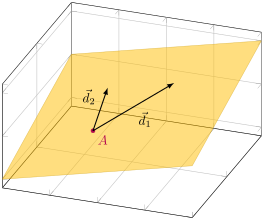
Any two distinct points define a line. To define a plane, we need three points. But there’s a caveat: the three points cannot be on the same line, otherwise they’d define a line and not a plane. Let \(A,B,C\in\R^{3}\) be three points that are not collinear and let \(\mathcal{P}\) be the plane that passes through \(A\text{,}\)\(B\text{,}\) and \(C\text{.}\)
Just like lines, planes have direction vectors. For \(\mathcal{P}\text{,}\) both \(\vec d_{1}=\overrightarrow{AB}\) and \(\vec d_{2}=\overrightarrow{AC}\) are direction vectors. Of course, \(\vec d_{1}\text{,}\)\(\vec d_{2}\) and their multiples are not the only direction vectors for \(\mathcal{P}\text{.}\) There are infinitely many more, including \(\vec d_{1}+\vec d_{2}\text{,}\) and \(\vec d_{1}-7\vec d_{2}\text{,}\) and so on. However, since a plane is a two-dimensional object, we only need two different direction vectors to describe it.
Like lines, planes have a vector form. Using the direction vectors \(\vec d_{1}=\overrightarrow{AB}\) and \(\vec d_{2}=\overrightarrow{AC}\text{,}\) the plane \(\mathcal{P}\) can be written in vector form as
A plane \(\mathcal{P}\) is written in vector form if it is expressed as
\begin{equation*}
\vec x=t\vec d_{1}+s\vec d_{2}+\vec p
\end{equation*}
for some vectors \(\vec d_{1}\) and \(\vec d_{2}\) and point \(\vec p\text{.}\) That is, \(\mathcal{P} = \{\vec x: \vec x= t\vec d_{1}+s\vec d_{2}+\vec p\text{ for some }t,s\in\R \}\text{.}\) The vectors \(\vec d_{1}\) and \(\vec d_{2}\) are called direction vectors for \(\mathcal{P}\text{.}\)
Example2.3.3.
Describe the plane \(\mathcal{P}\subseteq \R^{3}\) with equation \(z=2x+y+3\) in vector form.
Solution.
To describe \(\mathcal{P}\) in vector form, we need a point on \(\mathcal{P}\) and two direction vectors for \(\mathcal{P}\text{.}\) By guess-and-check, we see the points
Just like in the example for lines, we are looking for points \(\vec x\) that are in both planes. To keep from getting mixed up, we’ll use \(a\text{,}\)\(b\text{,}\)\(c\text{,}\) and \(d\) as parameter variables. Therefore, we are looking for solutions to
This system is underdetermined (there are four variables and three equations). If \(\mathcal{P}_{1}\) and \(\mathcal{P}_{2}\) indeed intersect in a line, we know there must be an infinite number of solutions to this system. After row reducing 1
is a solution for every \(r\in\R\text{.}\) We can substitute these parameters into either of the original equations to get an equation for the line of intersection. Picking the second one, we see
Using vectors, we can describe more than just lines and planes—we can describe all sorts of geometric objects.
Recall that when we write \(\vec x=t\vec d+\vec p\) to describe the line \(\ell\text{,}\) what we mean is
\begin{equation*}
\ell=\Set{\vec x\given \vec x=t\vec d+\vec p\text{ for some }t\in \R}.
\end{equation*}
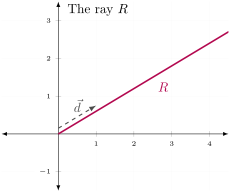
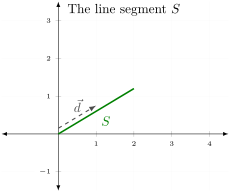
The line \(\ell\) stretches off infinitely in both directions. But, what if we wanted to describe just a part of \(\ell\text{?}\) We can do this by placing additional restrictions on \(t\text{.}\) For example, consider the ray \(R\) and the line segment \(S\text{:}\)
\begin{align*}
R&=\Set{\vec x\given \vec x=t\vec d+\vec p\text{ for some }t\geq 0}\\
S&=\Set{\vec x\given \vec x=t\vec d+\vec p\text{ for some }t\in [0,2]}
\end{align*}
Figure2.4.1.
Figure2.4.2.
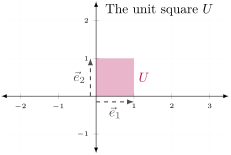
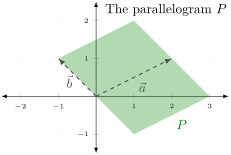
We can also make polygons by adding restrictions to the vector form of a plane. Let \(\vec a=\mat{2\\1}\) and \(\vec b=\mat{-1\\1}\) and consider the unit square \(U\) and the parallelogram \(P\) defined by
\begin{align*}
U&=\Set{\vec x\given \vec x=t\xhat+s\yhat\text{ for some }t,s\in [0,1]}\\
P&=\Set{\vec x\given \vec x=t\vec a+s\vec b\text{ for some }t\in [0,1]\text{ and }s\in[-1,1]}
\end{align*}
Figure2.4.3.
Figure2.4.4.
Each set so far is a set of linear combinations, and we have made different shapes by restricting the coefficients of those linear combinations. There are two ways of restricting linear combinations that arise often enough to get their own names.
Definition2.4.5.Non-negative & Convex Linear Combinations.
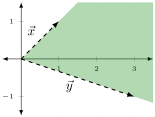
Let \(\vec w=\alpha_{1}\vec v_{1}+\alpha_{2}\vec v_{2}+\cdots+\alpha_{n}\vec v_{n}.\) The vector \(\vec w\) is called a non-negative linear combination of \(\vec v_{1},\vec v_{2},\ldots,\vec v_{n}\) if
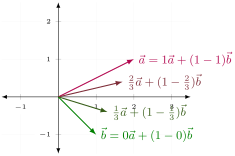
You can think of non-negative linear combinations as vectors you can arrive at by only displacing “forward”. Convex linear combinations can be thought of as weighted averages of vectors (the average of \(\vec v_{1},\ldots, \vec v_{n}\) would be the convex linear combination with coefficients \(\alpha_{i}=\frac{1}{n}\)). A convex linear combination of two vectors gives a point on the line segment connecting them.
Example2.4.6.
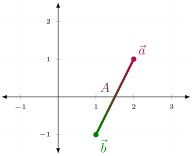
Let \(\vec a=\mat{2\\1}\) and \(\vec b=\mat{1\\-1}\) and define
\begin{align*}
A&=\Set{\vec x\given \vec x\text{ is a convex linear combination of }\vec a\text{ and }\vec b}\\
&=\Set{\vec x\given \vec x=\alpha\vec a+(1-\alpha)\vec b\text{ for some }\alpha\in [0,1]}.
\end{align*}
Draw \(A\text{.}\)
Solution.
We know \(\vec x=\alpha\vec a+(1-\alpha)\vec b\in A\) whenever \(\alpha\in[0,1]\text{.}\) If we rearrange the equation \(\vec x=\alpha\vec a+(1-\alpha)\vec b\text{,}\) we see
which looks like the vector form of a line which passes through \(\vec b\) with direction \(\vec a-\vec b\text{.}\) However, we have the additional restriction \(\alpha\in[0,1]\text{,}\) so \(A\) is only the part of that line which connects \(\vec a\) and \(\vec b\text{.}\)
Figure2.4.7.
Figure2.4.8.
Since \(A\) is an infinite collection of vectors, it’s better to draw vectors in \(A\) as dots rather than lines from the origin.
Exercises2.5Exercises
1.
Express the following lines in vector form.
\(\ell_{1}\subseteq\R^{2}\) with equation \(4x-3y=-10\text{.}\)
\(\ell_{2}\subseteq\R^{2}\) which passes through the points \(A=(1,1)\) and \(B=(2,7)\text{.}\)
\(\ell_{3}\subseteq\R^{2}\) which passes through \(\vec 0\) and is parallel to the line with equation \(4x-3y=-10\text{.}\)
\(\ell_{4}\subseteq\R^{3}\) which passes through the points \(A=(-1,-1,0)\) and \(B=(2,3,5)\text{.}\)
\(\ell_{5}\subseteq\R^{3}\) which is contained in the \(yz\)-plane and where the coordinates of every point in \(\ell_{5}\) satisfy \(x+2y-3z=5\text{.}\)
\(\mathcal{P}_{1}\subseteq\R^{3}\) with equation \(4x-z=0\text{.}\)
\(\mathcal{P}_{2}\subseteq\R^{3}\) which passes through the points \(A=(-1,-1,0)\text{,}\)\(B=(2,3,5)\text{,}\) and \(C=(3,3,3)\text{.}\)
\(\mathcal{P}_{3}\subseteq\R^{3}\) with equation \(4x-3y+z=-10\text{.}\)
\(\mathcal{P}_{4}\subseteq\R^{3}\) which is parallel to the \(yz\)-plane and passes through the point \(X=(1,-1,1)\text{.}\)
\(\R^{2}\text{.}\)
\(\mathcal{P}_{5}\subseteq\R^{4}\) which passes through \(A=(1,-1,1,-1)\text{,}\) and where the coordinates of every point in \(\mathcal{P}_{5}\) satisfy the equations \(x+y+2z-w=3\) and \(x+y+z+w=0\text{.}\)
Let \(\mathcal{P}_{1}\subseteq\R^{3}\) be the plane with equation \(x+2y-z=3\text{.}\) Let \(\mathcal{P}_{2}\) and \(\ell\) be described in vector form by
Give an example of a plane \(\mathcal{P}_{3}\) so that \(\mathcal{P}_{3}\cap\ell\) is empty.
Does there exist a plane \(\mathcal{P}_{2}'\) that is parallel to \(\mathcal{P}_{2}\text{,}\) but which does not intersect \(\ell\text{?}\) Why or why not?
Suppose \(\mathcal{P}_{2}'\) is a plane that is parallel to \(\mathcal{P}_{2}\text{.}\) Notice that \(\mathcal{P}_{2}'\) can be expressed with the equation \(x-y=c\) for some \(c\in\R\text{.}\)
Finding such a plane \(\mathcal{P}_{2}'\) which does not intersect \(\ell\) is now equivalent to finding a number \(c\in\R\) so that \((1+t)-(1+3t) \neq c\) for all \(t\in\R\text{.}\) But, \(t=-1/2c\) solves the equation \((1+t)-(1+3t)=c\text{,}\) so any plane \(\mathcal{P}_{2}'\) that is parallel to \(\mathcal{P}_{2}\) must intersect \(\ell\text{.}\)
5.
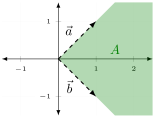
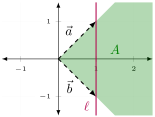
Let \(\vec a=\mat{1\\1}\) and \(\vec b=\mat{1\\-1}\text{.}\) The goal of this question is to produce a drawing of the set of convex linear combinations of \(\vec a\) and \(\vec b\text{.}\)
Let \(A\) be the set of all non-negative linear combinations of \(\vec a\) and \(\vec b\text{.}\) Draw \(A\text{.}\)
Let \(\ell\) be the set
\begin{equation*}
\Set{\alpha \vec a + \beta \vec b\given \alpha, \beta \in \R\text{ and } \alpha+\beta = 1}
\end{equation*}
Rewrite \(\ell\) in set-builder notation using only a single variable \(t\text{.}\) (Hint: Let \(t\) be \(\alpha\text{.}\))
Justify why \(\ell\) is a line, and write \(\ell\) in vector form.
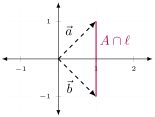
Draw both \(A\) and \(\ell\) on the same grid. On a separate grid, draw \(A\cap \ell\text{.}\)
Write the \(A \cap \ell\) in set-builder notation. How does \(A\cap \ell\) relate to convex linear combinations?
Determine the endpoints of \(A \cap \ell\text{.}\)
Solution.
Figure2.5.1.
\(\ell\) is given by the set
\begin{equation*}
\Set{\vec x\in\R^2\given \vec x=t \vec a + (1-t) \vec b\text{ for some }t\in\R}.
\end{equation*}
The above set can be rewritten as
\begin{equation*}
\Set{\vec x\in\R^2\given \vec x=t (\vec a - \vec b)+\vec b\text{ for some }t\in\R}.
\end{equation*}
This is exactly the line given in vector form by
\begin{equation*}
\vec x = t(\vec a - \vec b)+\vec b.
\end{equation*}
Since \(\vec a-\vec b=\mat{0\\2}\text{,}\)\(\ell\) is the vertical line containing \(\vec b\) (and \(\vec a\)).
This is the set of convex linear combinations of \(\vec a\) and \(\vec b\text{.}\)
The endpoints of \(A\cap\ell\) are \(\vec{a}\) and \(\vec{b}\text{.}\)
6.
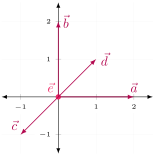
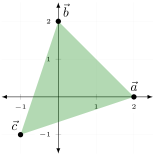
Let \(\vec a=\mat{2 \\0}\text{,}\)\(\vec b=\mat{0 \\ 2}\text{,}\) and \(\vec c=\mat{-1 \\ -1}\text{.}\) The goal of this question is to produce a drawing of the set of convex linear combinations of \(\vec a\text{,}\)\(\vec b\text{,}\) and \(\vec c\text{.}\) This requires an understanding of the previous question.
Let \(\vec d=\mat{1 \\ 1}\text{.}\) Write \(\vec d\) as a convex linear combination of \(\vec a\) and \(\vec b\text{.}\)
Let \(\vec e=\mat{0 \\ 0}\text{.}\) Write \(\vec e\) as a convex linear combination of \(\vec c\) and \(\vec d\text{.}\)
Substituting the answer to (2.5.6.a) into the answer to part (2.5.6.b), write \(\vec e\) as a convex linear combination of \(\vec a\text{,}\)\(\vec b\text{,}\) and \(\vec c\text{.}\)
Draw and label \(\vec a\text{,}\)\(\vec b\text{,}\)\(\vec c\text{,}\)\(\vec d\text{,}\) and \(\vec e\) on the same grid.
Draw the set of convex linear combinations of \(\vec a\text{,}\)\(\vec b\text{,}\) and \(\vec c\text{.}\) Justify your answer.
The set is the filled-in triangle with vertices given by \(\vec a\text{,}\)\(\vec b\text{,}\) and \(\vec c\text{.}\) To see this, notice that the set of convex linear combinations of \(\vec a\text{,}\)\(\vec b\text{,}\) and \(\vec c\) is the set of convex linear combinations of \(\vec c\) and any convex linear combination of \(\vec a\) and \(\vec b\text{.}\) Indeed,
\begin{equation*}
\begin{split}&\alpha_{1}\vec a+\alpha_{2}\vec b+ \alpha_{3}\vec c \\&\qquad= (1-\alpha_{3})\left(\tfrac{\alpha_1}{1-\alpha_3}\vec a + \tfrac{\alpha_2}{1-\alpha_3}\vec b\right)+\alpha_{3}\vec c,\end{split}
\end{equation*}
and \(\alpha_{1}\vec a+\alpha_{2}\vec b+ \alpha_{3}\vec c\) is a convex linear combination of \(\vec a\text{,}\)\(\vec b\text{,}\) and \(\vec c\) exactly when
\begin{equation*}
\frac{\alpha_{1}}{1-\alpha_{3}}\vec a + \frac{\alpha_{2}}{1-\alpha_{3}}\vec b
\end{equation*}
is a convex linear combination of \(\vec a\) and \(\vec b\) (verify this!). By the previous part, the set of convex linear combinations of \(\vec a\) and \(\vec b\) is the line segment between \(\vec a\) and \(\vec b\text{.}\) Call this line segment \(S\text{.}\) Now we know the set of convex linear combinations of \(\vec a\text{,}\)\(\vec b\text{,}\) and \(\vec c\) is the union of every line segment from \(\vec c\) and a vector in \(S\text{.}\) This is the filled-in triangle with vertices given by \(\vec a\text{,}\)\(\vec b\text{,}\) and \(\vec c\text{.}\)
7.
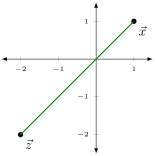
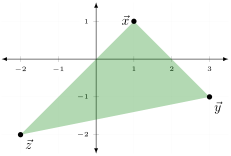
Let \(\vec x=\mat{1 \\ 1}\text{,}\)\(\vec y = \mat{3 \\ -1}\) and \(\vec z=\mat{-2 \\ -2}.\) Draw the following subsets of \(\R^{2}\text{.}\)
All non-negative linear combinations of \(\vec x\) and \(\vec y\text{.}\)
All non-negative linear combinations of \(\vec x\) and \(\vec z\text{.}\)
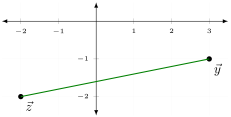
All convex linear combinations of \(\vec y\) and \(\vec z\text{.}\)
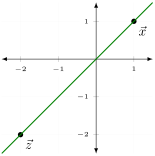
All convex linear combinations of \(\vec x\) and \(\vec z\text{.}\)
All convex linear combinations of \(\vec x\text{,}\)\(\vec y\) and \(\vec z\text{.}\)
Solution.
Figure2.5.6.
Figure2.5.7.
Figure2.5.8.
Figure2.5.9.
Figure2.5.10.
8.
Describe the sets in (2.5.7.c) and (2.5.7.d) in set-builder notation.
\begin{equation*}
\Set{\vec w \in \R^{2}\given \vec w=t\mat{-3\\-3}+\mat{1\\1}\text{ for some }0\leq t\leq 1}.
\end{equation*}
9.
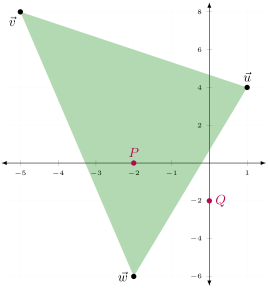
Determine if the points \(P=(-2,0)\) and \(Q=(0,-2)\) are convex linear combinations of the vectors \(\vec u =\mat{1 \\4}\text{,}\)\(\vec v =\mat{-5 \\8}\text{,}\) and \(\vec w =\mat{-2 \\-6}\text{.}\) First solve this question by drawing a picture. Then justify algebraically.
Solution.
Figure2.5.11.
Geometrically, the set of convex linear combinations of \(\vec u\text{,}\)\(\vec v\text{,}\) and \(\vec w\) is a filled-in triangle with vertices at \(\vec u, \vec v\) and \(\vec w\text{.}\) The point \(P\) lies inside this triangle, while \(Q\) does not.
To argue algebraically, suppose \(P=t_{1}\vec u + t_{2}\vec v + t_{3}\vec w\) and \(t_{1}+t_{2}+t_{3}=1\text{.}\) From these assumptions, we can set up a system of equations which has a unique solution
\begin{equation*}
P=\tfrac14 \vec u + \tfrac14 \vec v + \tfrac12 \vec w,
\end{equation*}
and so \(P\) is a convex linear combination of \(\vec u\text{,}\)\(\vec v\text{,}\) and \(\vec w\text{.}\) The same procedure with \(Q\) gives a unique solution with coefficients \(t_{1}=\frac{5}{9}, t_{2}=-\frac{1}{9}, t_{3}=\frac{5}{9}\text{,}\) and so \(Q\) is not a convex linear combination of \(\vec u\text{,}\)\(\vec v\text{,}\) and \(\vec w\text{.}\)