Unit 13: Series
Warning. Students find this material very difficult. There are lots of little concepts and little results. Individually, they are not too hard, but they become a big mess if we move on too quickly before students have absorbed each piece.Resist the temptation to spend time on “interesting” questions unless students have fully understood the basics. Go slowly. They will appreciate working on what you may consider “trivial” questions so as to gain confidence.
OBJECTIVES
-
Never confuse a sequence with a series. Use proper notation for both concepts.
-
Like for improper integrals, understand that an infinite sum is a new concept that we have to define.
-
Understand the definition, be able to explain it, and use it to compute the value of simple series (mostly geometric and telescopic series).
-
Estimate a series numerically.
-
Know that we cannot take for granted that properties of finite sums carry to infinite sums. Know which properties carry and prove so from the definition.
-
State the standard convergence tests and justify intuitively why they work (even if not formally prove them). Correctly use them to determine whether a series is convergent (and even conditionally convergent or absolutely convergent) or divergent, as well as in simple proofs.
Definition of series
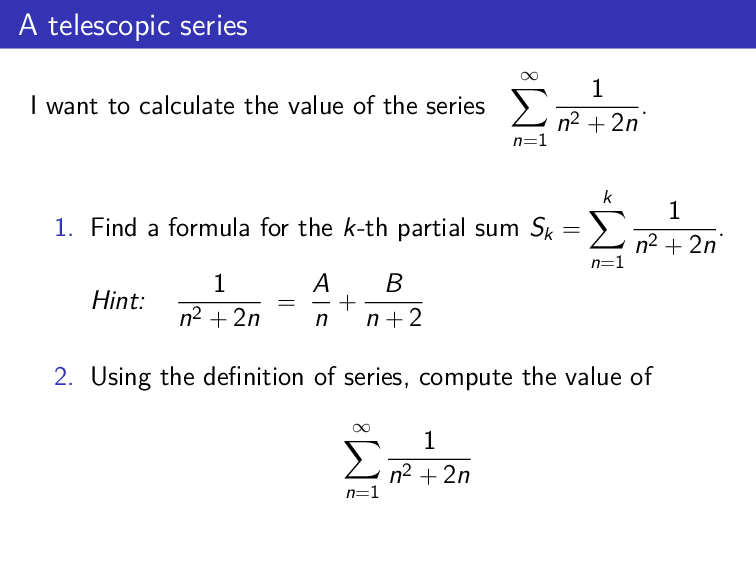
Telescopic series
A telescopic series
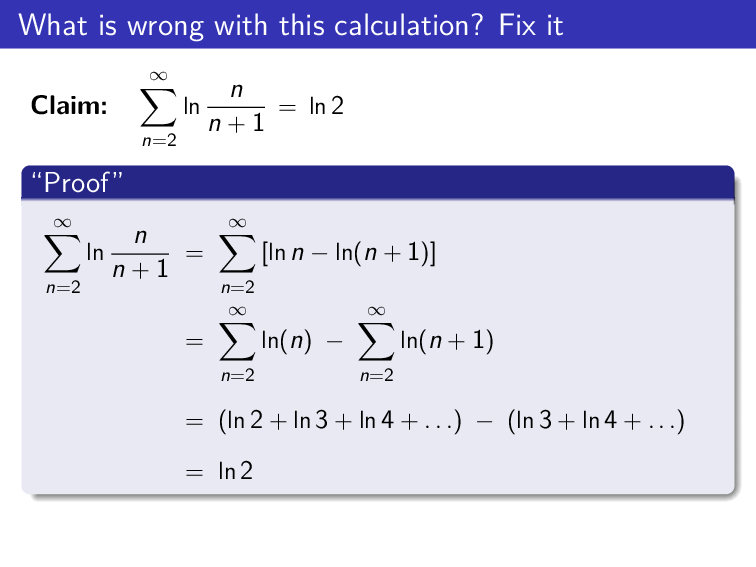
What is wrong with this calculation? Fix it
Trig series
Trig series: convergent or divergent?
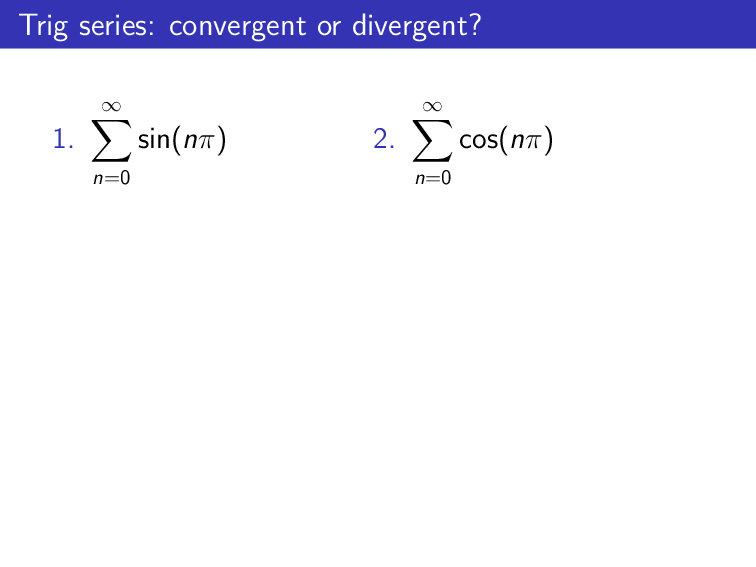
- Basic question to remind students of the simplest examples of divergent series.
Help me write the next assignment
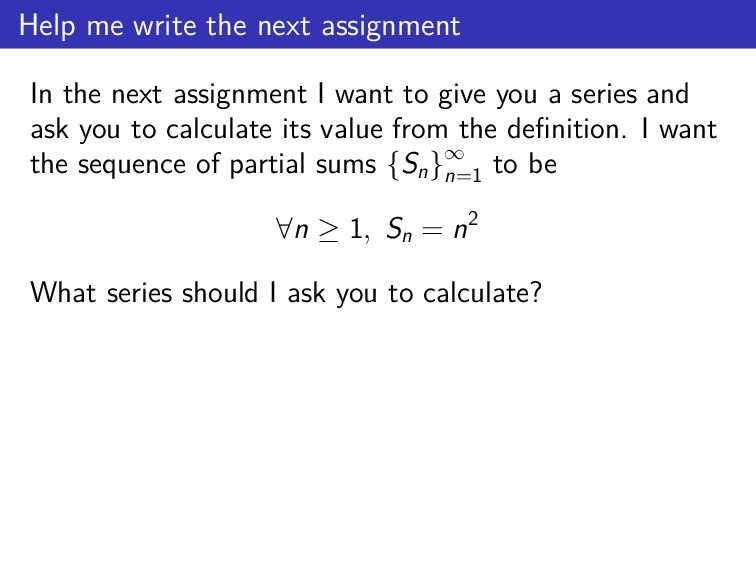
Help me write the next assignment
-
Simple question to hammer on the definition of series and of partial sums.
-
Answer:
Related Videos
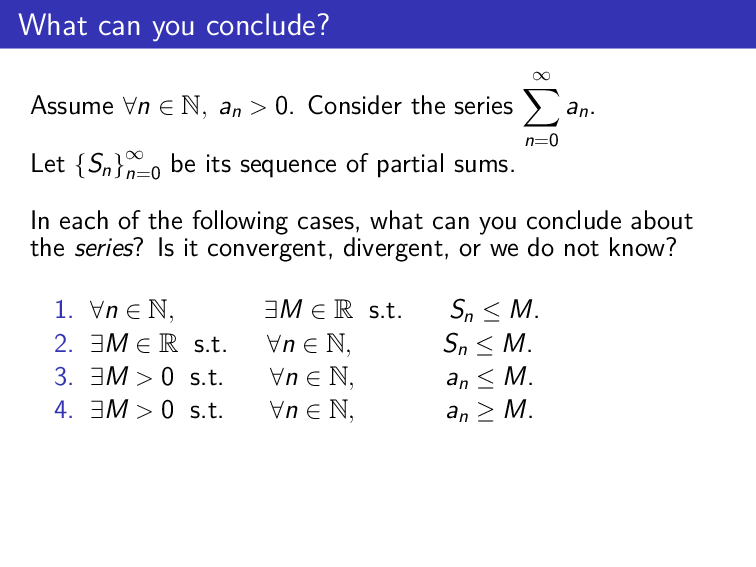
What can you conclude?
What can you conclude?
-
This activity foreshadows (slightly) positive series and comparison tests.
-
It also insist on the definition of series as a limit of partial sums.
-
Answers:
-
1 - we do not know: every series satisfies this
-
2 - convergent: the sequence of partial sums is increasing and bounded above
-
3 - we do not know
-
4 - divergent: the series grows faster than
-
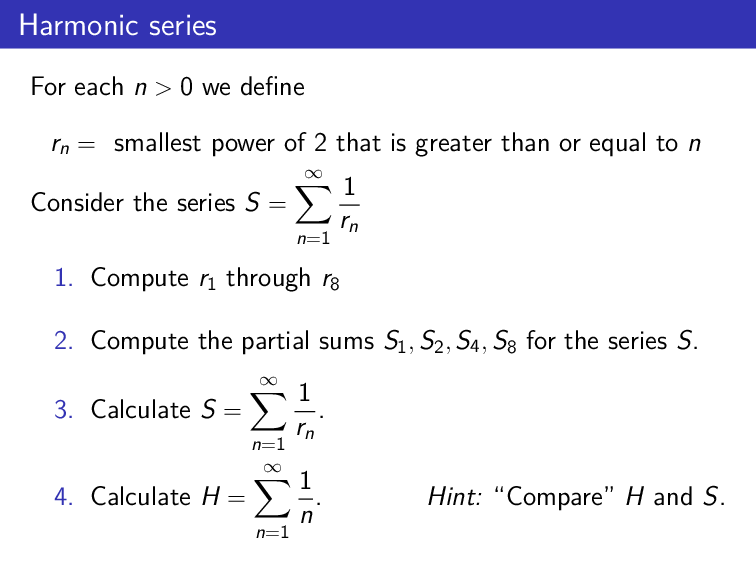
Harmonic series
Harmonic series
Warning. This is one of those activities that looks confusing, makes students react with “I do not know”, and tempts them to just wait for your answer while doing nothing. Unless you have enough time and a class that is willing to engage in collaboration, this activity is not worth it.
-
This question foreshadows comparison tests.
-
Students will later learn that the harmonic series diverges using the Integral Test.
This question is an attempt at doing an “elementary” proof from the definition of series.
-
How I use this question:
-
I give students a bit of time.
-
We discuss together the answer to 1.
-
I give students more time for the rest.
-
-
Answer:
-
,
-
,
-
,
-
,
-
...
-
True or False - Definition of series
True or False — Definition of series
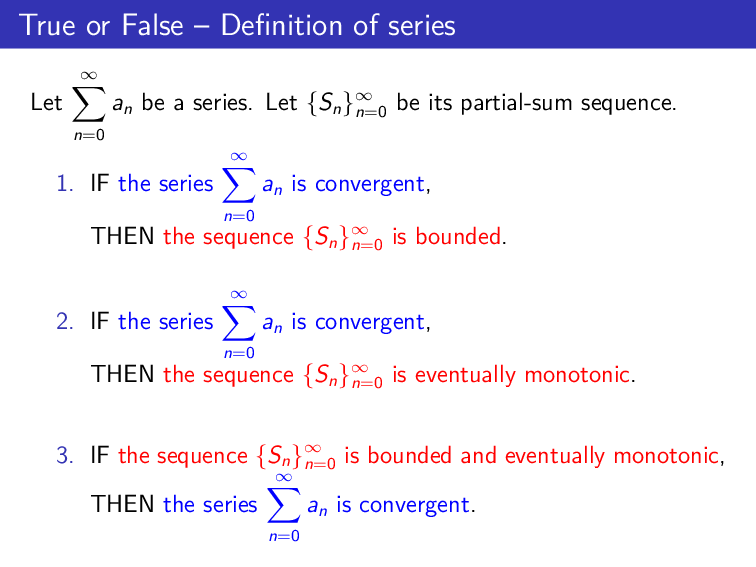
True or False — Definition of series
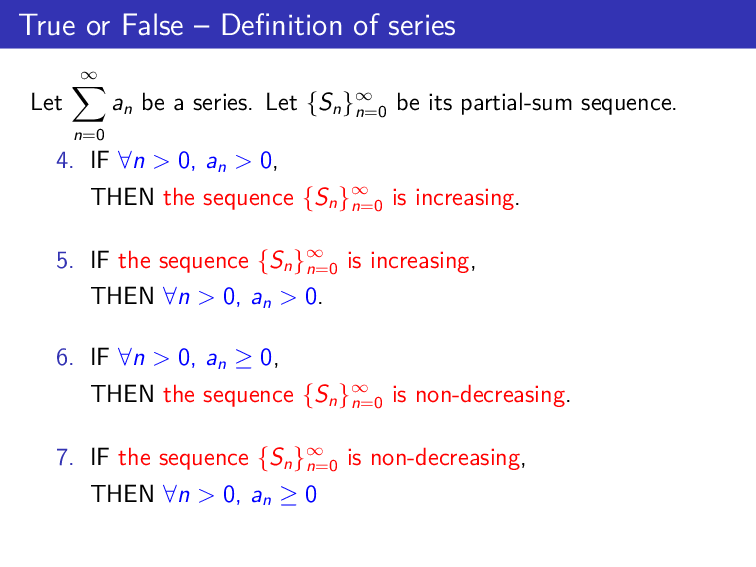
Warning. This activity is easy, but do not rush it.
-
This activity should be easy. It focuses on the definition of a series as the limit of the sequence of partial sums, together with properties of sequences.
-
Nevertheless, do not rush it! Students can answer this question, but it takes them time to wrap their heads around the notation and get comfortable with it. It is worth it to give them enough time to think through it and discuss it with their peers.
-
Answers: 1, 3, 4, 5, 6, 7 are true. 2 is false.
Related Videos
Geometric series
Rapid geometric series
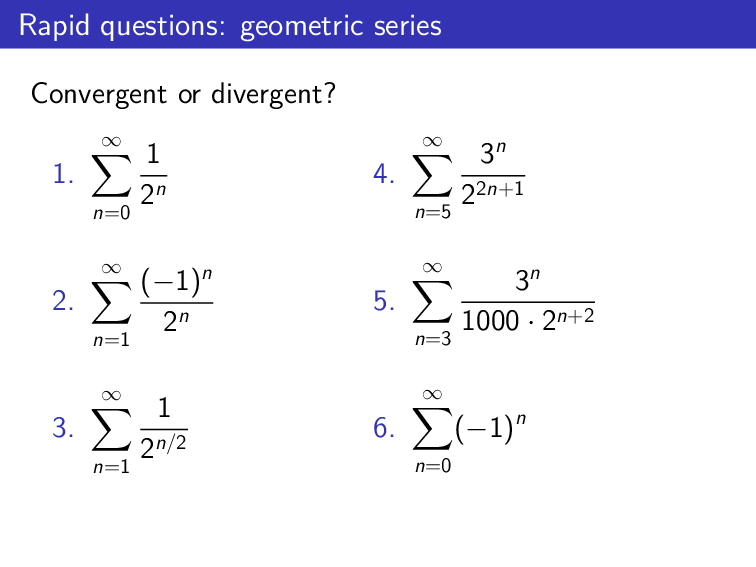
Rapid questions: geometric series
-
Short question to recognize geometric series even when they are “in disguise”.
-
Works well as a warm up.
-
Answer: 1, 2, 3, 4 are convergent. The rest are divergent.
Related Videos
Compute geometric series
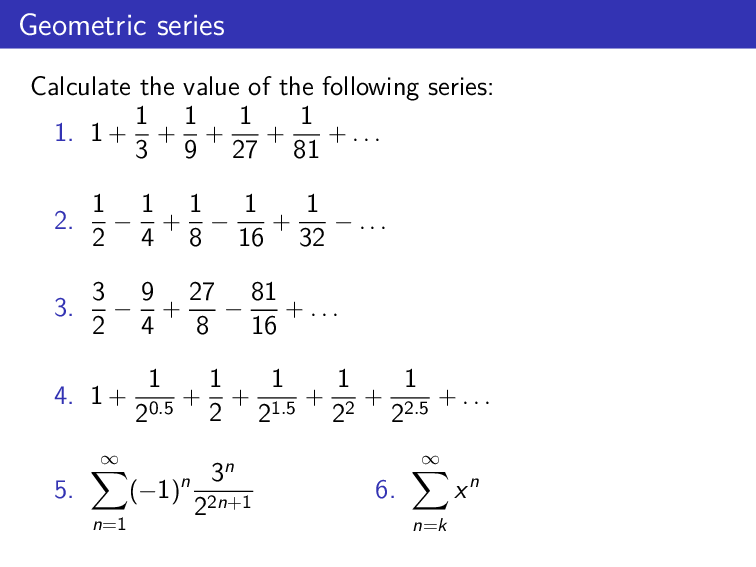
Geometric series
-
Simple question to recognize geometric series and add them up.
-
Students find this question accessible and even fun. Give them enough time and they will solve it.
-
There are some subtleties about Question 6:
-
They will forget we need to break this into cases, depending on whether .
-
The videos only introduce . Some of them learned in high school . “Are we allowed to use this other formula?” “Do we need to know it?”
-
If you try to reduce this problem to using the basic formula only “are we allowed to do those manipulations?”
-
-
Answers:
- divergent
- if .
Related Videos
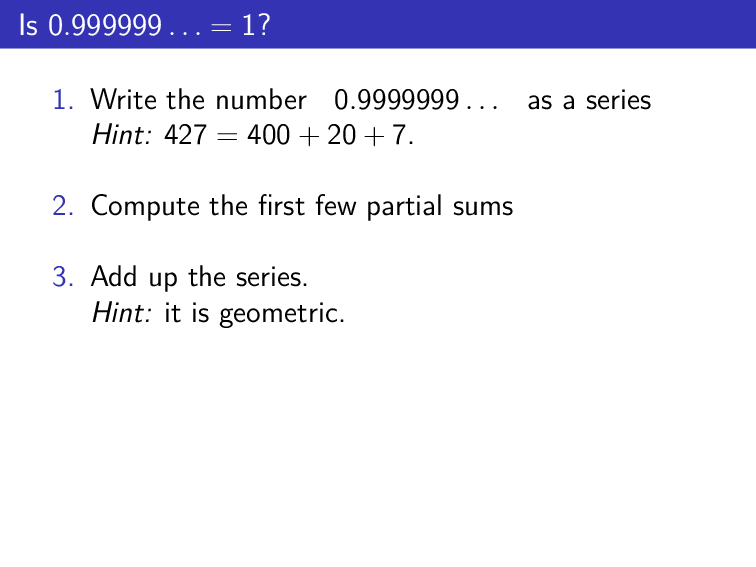
Is $\displaystyle 0.999999\ldots = 1$?
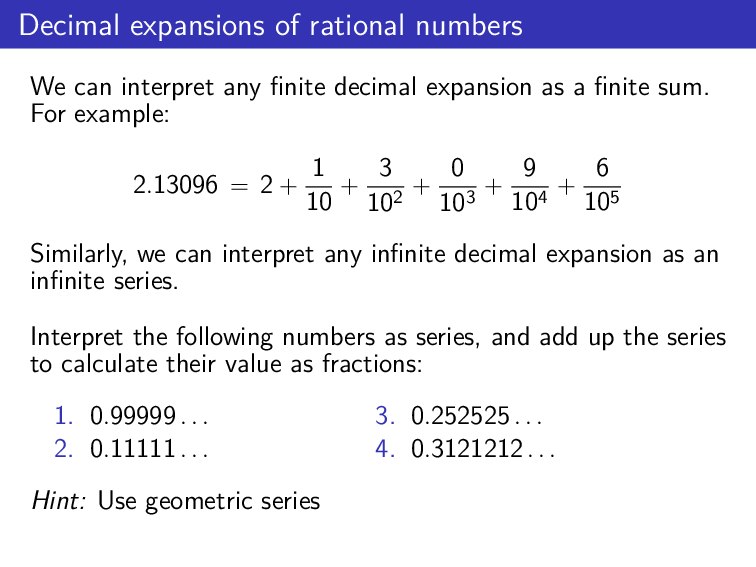
Decimal expansions of rational numbers
-
There are absurdly heated debates on the internet over whether . Read the Wikipedia article https://en.wikipedia.org/wiki/0.999... (opens in a new tab)and in particular the sections “Skepticism in education” and “Cultural phenomenon”.
-
Your class will be split between firm believers that they are different, confused students, believers that they are equal but who cannot prove it rigorously, and those who know what is going on.
Resist the temptation to rush or to lecture to your students and give them the answer. Proper understanding of what is going on is now within their reach if you give them enough time. Use this activity wisely and you will witness many “aha” moments, things finally clicking, and some minds blown.
-
After students have solve the question, it is appropriate to have a mini-lecture to explain how a decimal representation is just a way to represent a number, that the proper interpretation of such expansions is a series, and how it is reasonable for two decimal representations to represent the same number (just like two fractions can represent the same number).
-
Both of the slides serve the same purpose. I use one or the other depending on the time I want to spend.
-
Answers:
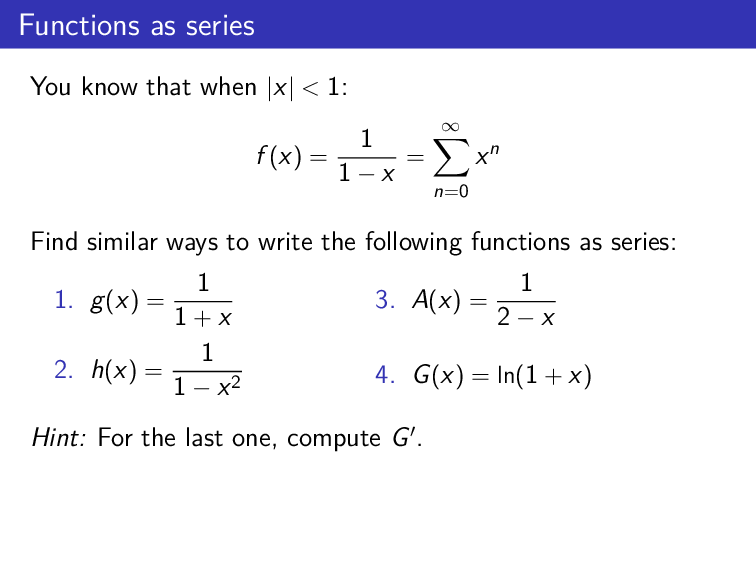
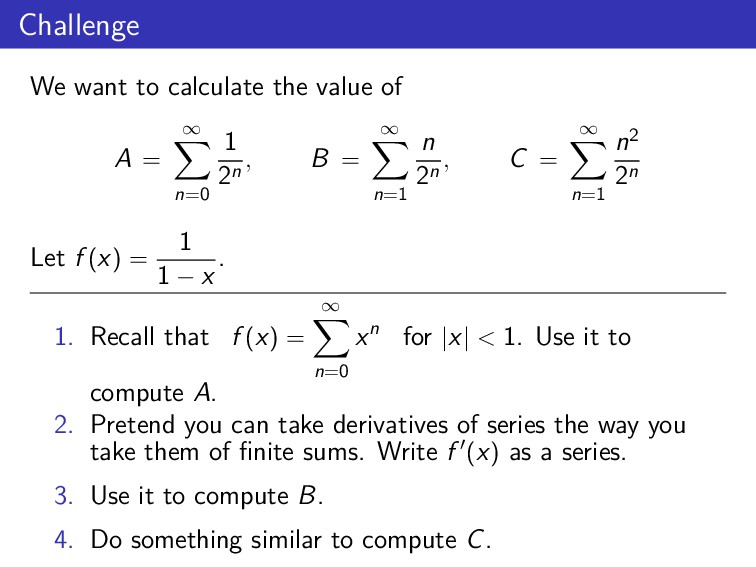
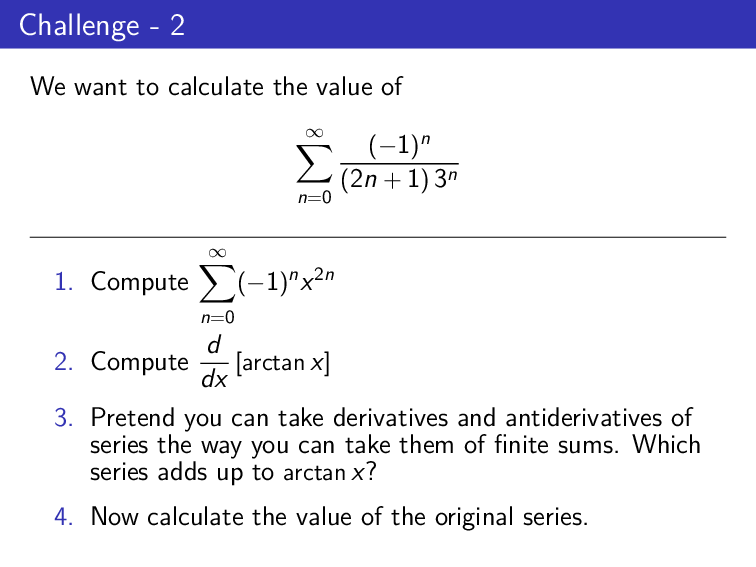
Power series advertising
Functions as series
Challenge
Challenge - 2
-
The good:
-
These activities serve as an advertisement for why we will spend Unit 14 studying power series.
-
If successful, students will be impressed and intrigued.
-
-
The bad:
-
These activities are hard and take a lot of time!
-
Resist the temptation to rush into them unless you have enough time and students are very comfortable with the basics. If you are going to end up explaining the answer yourself, rather than having students discover it, they are not worth it.
-
If unsure, solidifying the basics of series is probably more important. After all, none of these questions are “necessary” at this point in the unit. Students will eventually learn this in Unit 14 anyway.
-
Related Videos
Basic properties of series
Examples
Examples
-
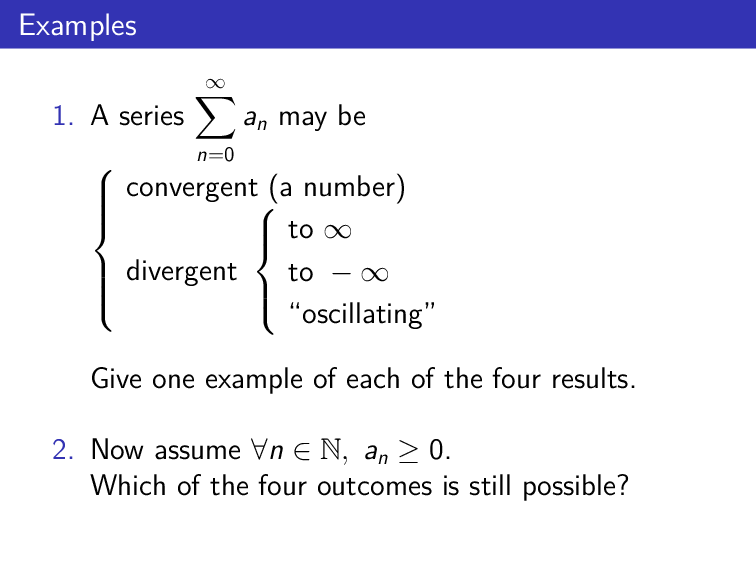
Simple question that anticipates positive series.
-
Some students mistakenly think that is an example of positive series that is “oscillating”.
Remind them that “oscillating” means “divergent, but neither or ”, and not simply that the terms alternate between increasing and decreasing.
True or False - Tail of a series
True or False — The tail of a series
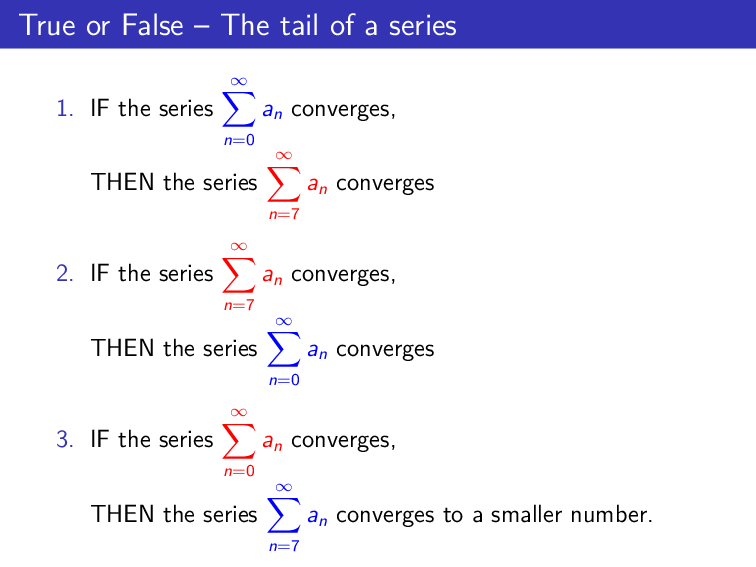
Warning. I suggest not skipping this question. This result is essential.
-
This activity foreshadows the “tail of a series” (whether a series converges depends only on the tails).
-
Common point of confusion: some students will think that provides a counterexample to 2. They are thinking that it is possible for to be divergent while is convergent as long as is divergent.
-
Answers: 1, 2 are true. 3 is false.
Related Videos
True or False - Necessary condition
True or False — The Necessary Condition
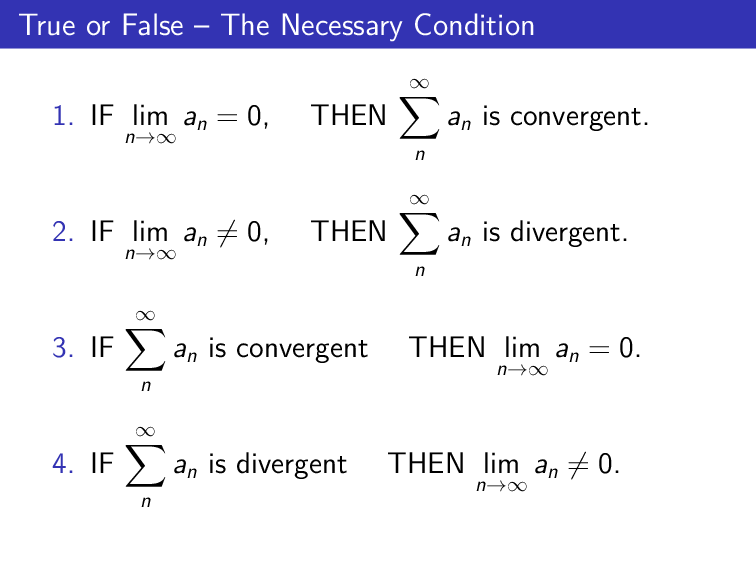
Warning. Do not skip this question!
-
This is one of the most important results about series, and one of the most commonly misused in tests and assignments. I would advise using this activity even more than once.
-
2, 3 are true. 1,4 are false.
True or False - Harder questions
True or False — Harder questions
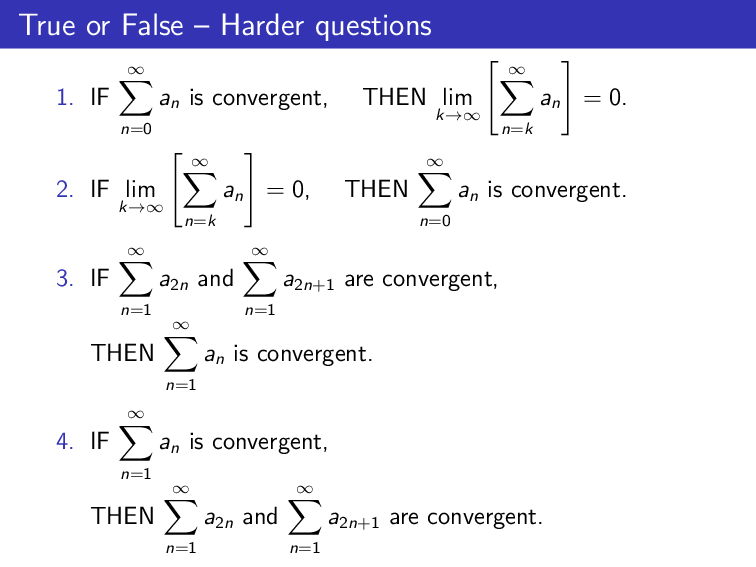
Warning. This is one of those activities that looks confusing, makes students react with “I do not know”, and tempts them to just wait for your answer while doing nothing. Unless you have enough time and a class that is willing to engage in collaboration, this activity is not worth it.
-
These questions are hard. Most students try to do them “by feeling”, just by looking at them and guessing, without writing anything down, or thinking of definitions. That is pretty much impossible.
-
If I use this question, I aggressively tell students to rewrite everything in terms of partial sums. Otherwise, they will get nowhere.
-
For 1 and 2, we need to notice that . This is obvious to you and me, but students do not think of it easily.
-
The notation in 3 and 4 will confuse students. It may be worth it to write the first few terms of the series to make sure they understand what they are working with.
-
Answers:
-
1 and 2 are true.
-
3 is true. , then use limit laws.
-
4 is false. Counterexample:
-
Series are linear
Series are linear
-
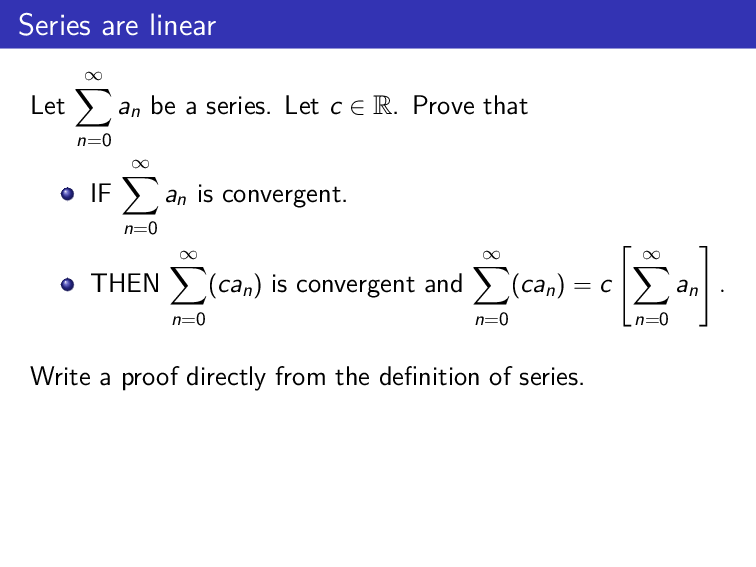
In Video 13.6 students learn that series are linear. The video proves additivity, but leaves scalar multiplication (the proof in this activity) as an exercise.
-
The goals of this activity include
-
We cannot assume all properties of finite sums carry on to infinite sums. We need to verify which ones do.
-
To prove they do carry, just use the definition of a series as a limit of partial sums.
-
-
This proof will be accessible to students who watched the videos.
Related Videos
Integral and comparison tests
Quick review of most useful improper integrals
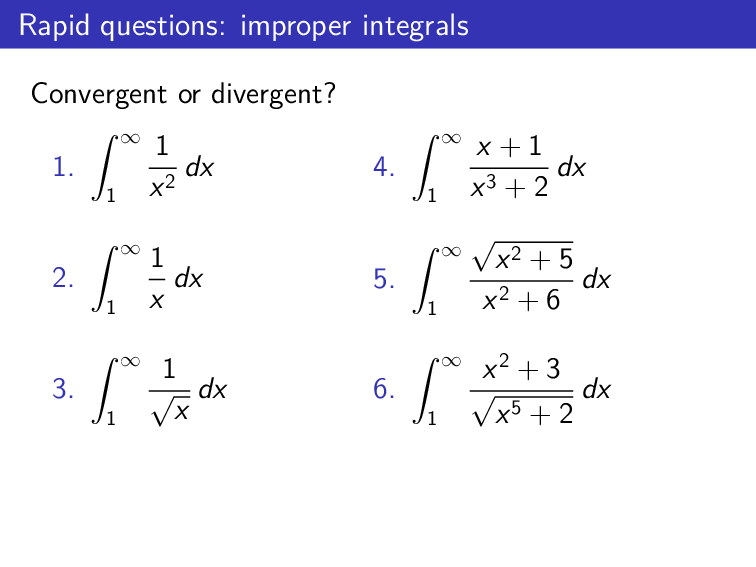
Rapid questions: improper integrals
-
I use this activity early in Unit 13 to keep these results (which belong to Unit 12) fresh and relevant in students’ minds.
We will need to recall them when we get to integral test and comparison tests for series.
-
Answers: 1, 4 are convergent. 2, 3, 5, 6 are divergent.
Related Videos
-series vs geometric series
For which values of $a \in \mathbb{R}$ are these series convergent?
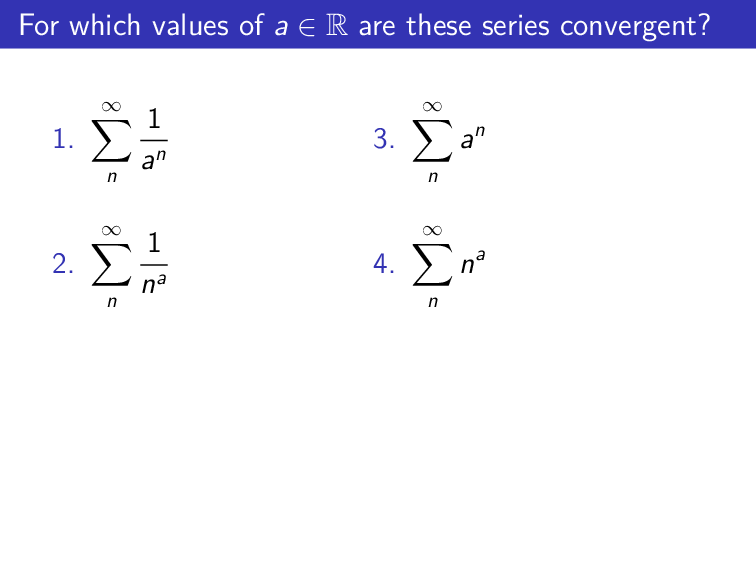
Warning. Do not skip this question!
-
This activity summarizes two essential families of series. We want students to be able to answer this in their sleep.
-
Answers:
Comparison and integral test practice
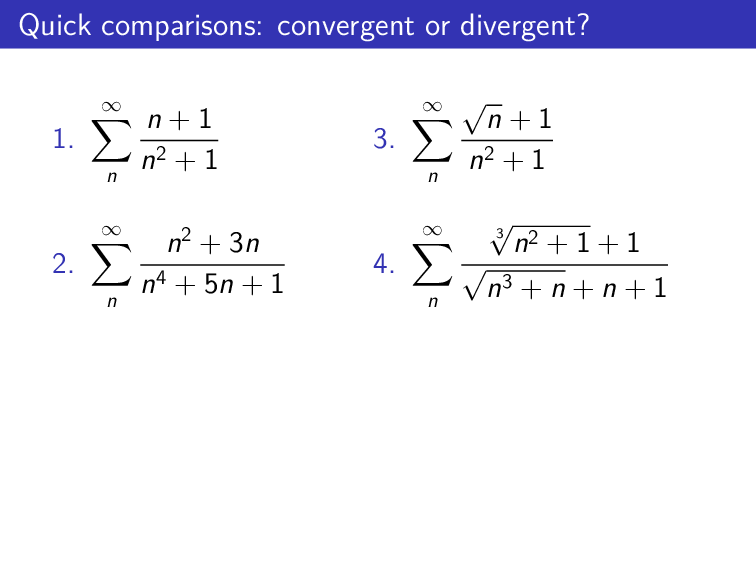
Quick comparisons: convergent or divergent?
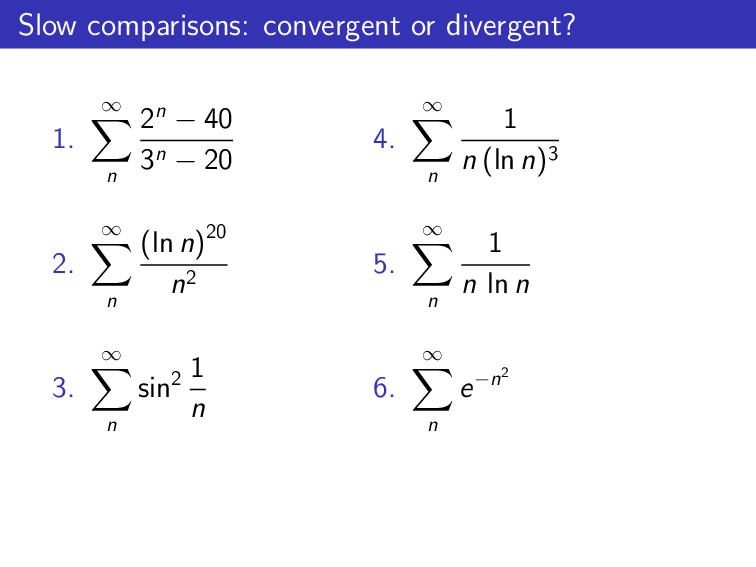
Slow comparisons: convergent or divergent?
-
Practice with standard applications of integral test and comparison tests.
-
Slide 1 contains easier questions. We want everybody to eventually be able to solve these in their sleep. Students will be slower than you think.
-
Slide 2 contains harder examples including some very challenging ones. You could easily spend a whole class just on this slide.
When I use it, I tell students to focus on Question X, Y, Z (the ones we will actually discuss), but the rest are there to keep faster students busy.
-
-
Students need the practice, and they will take a lot of time. It is time well spent.
-
Answers:
-
Slide 1. Use LCT with for an appropriate value of .
-
Slide 2
-
Convergent: LCT with a geometric series
-
Convergent: and use comparison tests
-
Convergent: LCT with
-
Convergent: Integral test.
-
Divergent: Integral test
-
Convergent: , then integral test. Or .
-
-
Abstract use of convergence tests
Convergence tests: ninja level
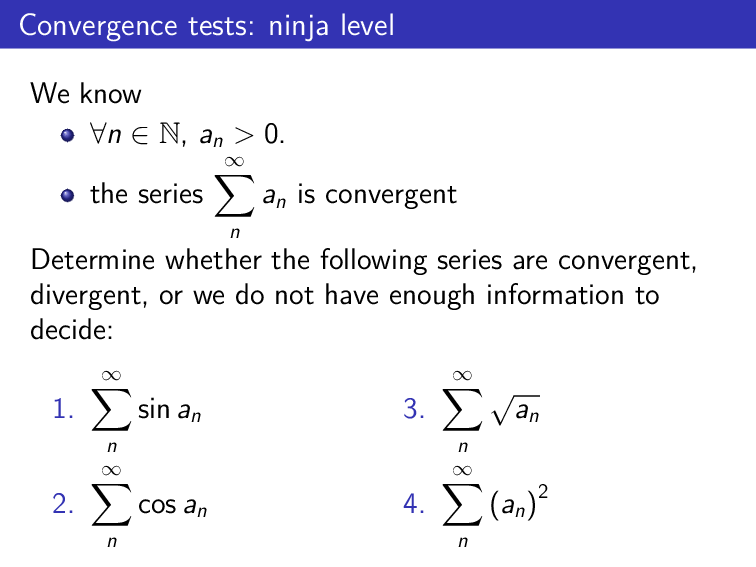
Warning. This is a great question. I am sure you like it already. As paradoxical as it may sound, do not rush to use it!
-
This is one of the most important questions in the unit, because it summarizes many ideas. If a student understands everything, then it is delightfully simple. Otherwise, it is impossible.
However this does not mean you should necessarily use it in class! If students are not comfortable with the basics, you will be wasting a great activity and they will not be able to to solve it. If you do not have time for it, do not worry: it is included in the practice problems and students will attempt it when studying for the test.
-
Answers. Since is convergent, we conclude .
-
Convergent. Use LCT as .
-
Divergent. .
-
No conclusion. Examples and .
-
Convergent. for large values of . Therefore . Use BCT.
-
Infinite decimal expansions are well-defined
Are all decimal expansions well-defined?
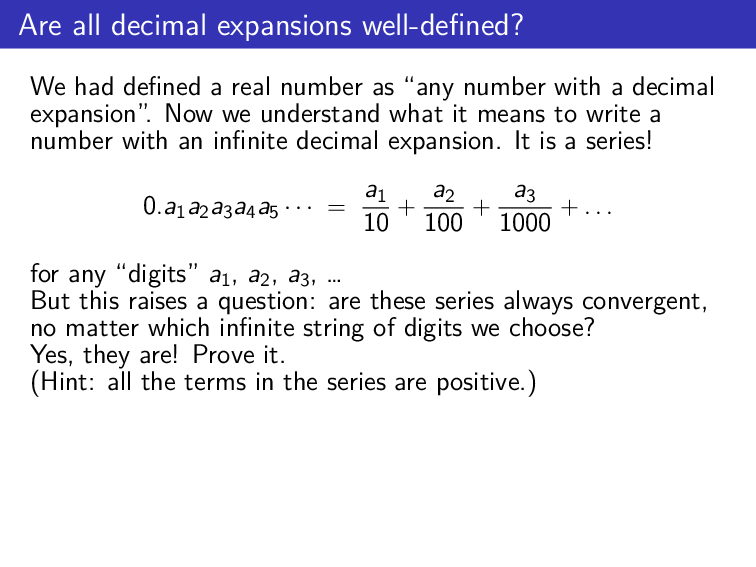
Warning. If you use this question, have a plan to make sure students understand what the point is, perhaps including a brief explanation before starting.
-
Answer: It is always convergent – compare it with using BCT.
-
This question is hard to use well. Students easily miss the point and do not understand what we are doing or why. Those who get it find the question easy (but perhaps satisfying). Those who don’t just wait without doing anything.
Alternating series
Rapid questions: alternating series test
Rapid questions: alternating series test
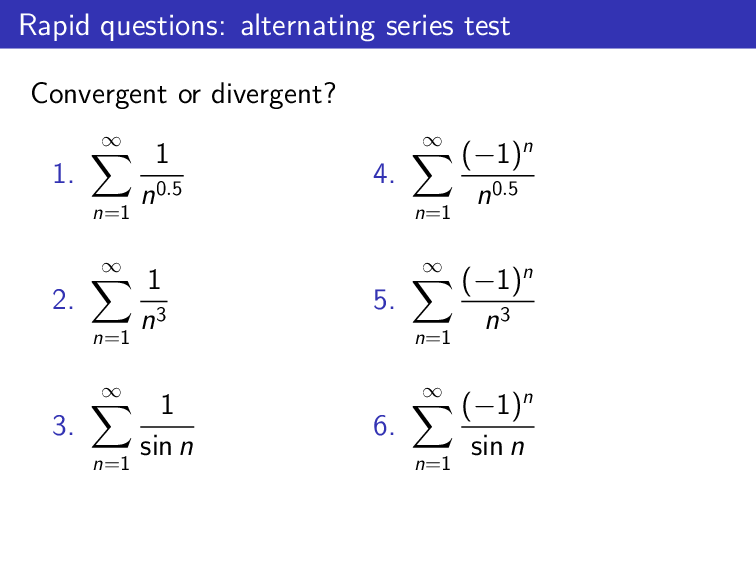
-
Simple question to check the statement of the alternating series test with very easy examples.
-
Answers: 2, 4, 5 are true; 1, 3, 6 are false.
True or False - Odd and even partial sums
True or False - Odd and even partial sums
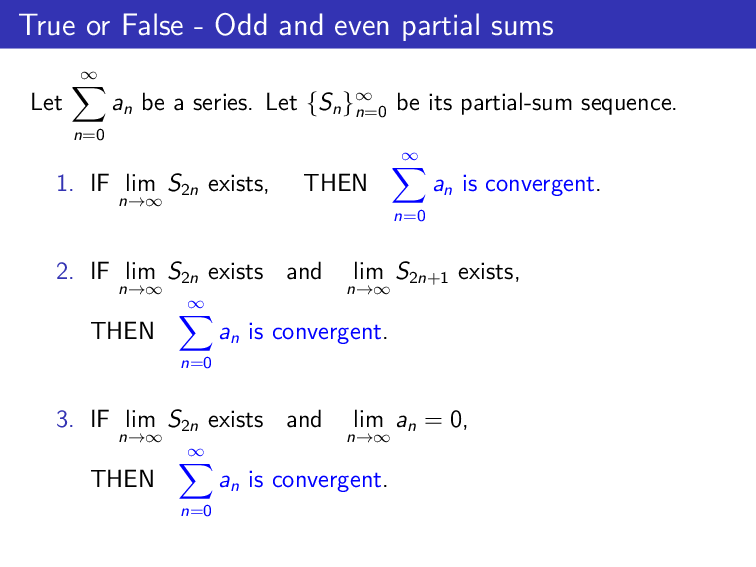
-
These questions address a step in the proof of the Alternating Series Test (Video 13.13) that students may miss.
-
Answer: In general, the sequence is convergent iff the two sequences and are convergent to the same limit.
3 is true; 1, 2 are false.
Related Videos
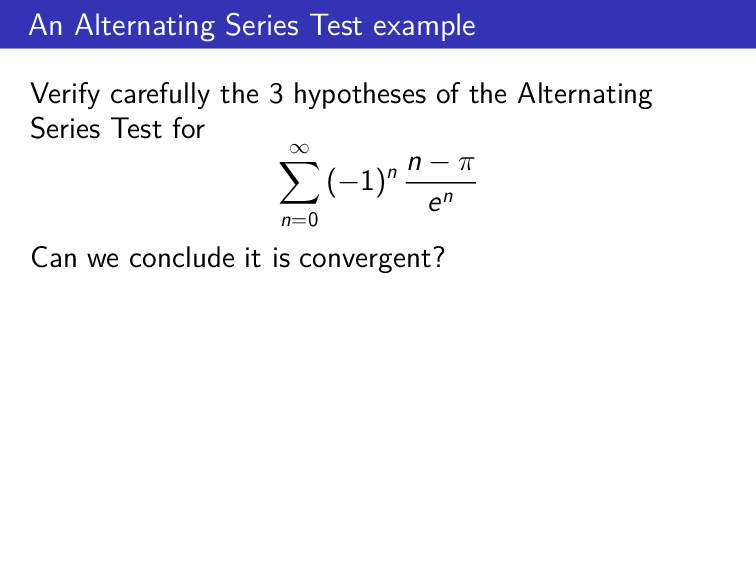
An alternating series test example
An Alternating Series Test example
-
The terms of these series only satisfy the hypotheses of the Alternating Series test eventually, but that is enough. That is the point of the question.
-
Some students mistakenly believe that we do not need to check the sequence to be (eventually) decreasing. They mistakenly reason: it is (eventually) positive and convergent to 0, so it must be (eventually) decreasing.
-
A simple way to check monotonicity is to extend to a function and take the derivative.
Related Videos
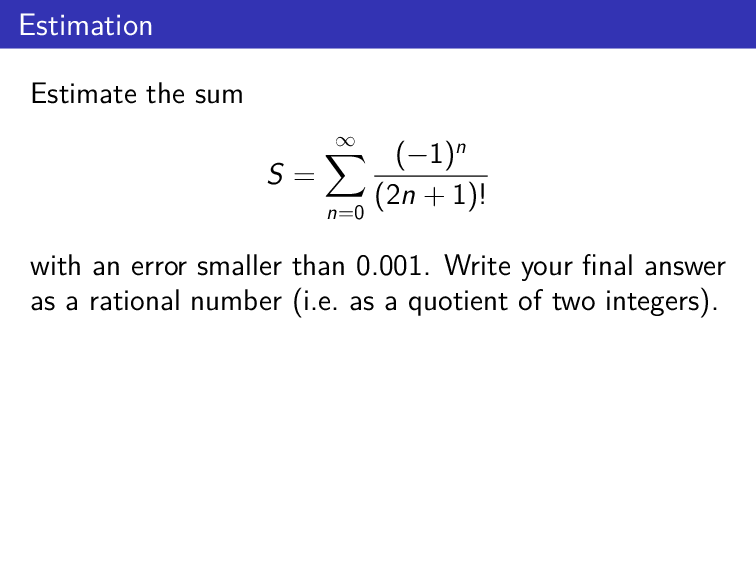
Estimation
Estimation
-
Standard application of the second half of the Alternating Series Theorem.
-
Answer: The smallest partial sum that works is because .
-
Common error: Many students correctly calculate that and therefore think we need to use as an estimate.
This error comes from memorizing the formula without thinking about why it is true.
Not exactly alternating
Not exactly alternating
-
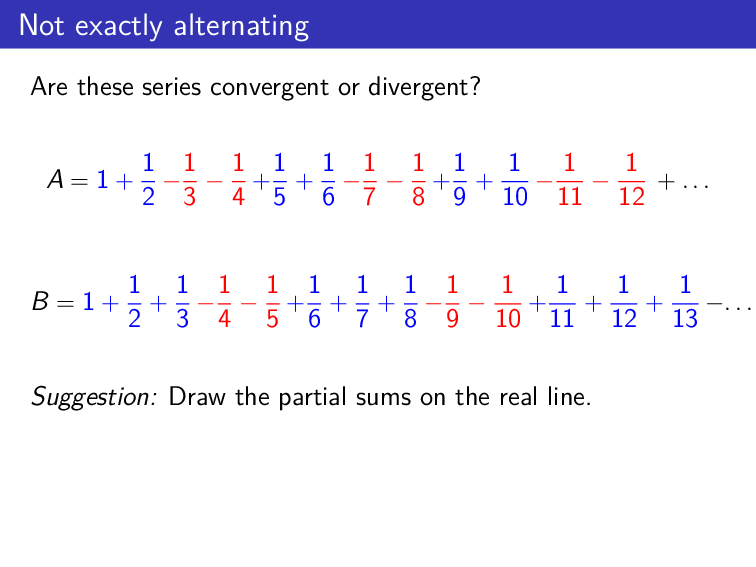
These two series have both positive and negative terms, but they are not alternating as in the Alternating Series Test. They are unlike any example students my have seen. The goal is to challenge them to be creative and come up with new tricks.
-
You will need to convince students to play and experiment. Most students reaction to this activity is “I do not know what to do. I will just wait for the answer”. Collaboration is essential for this activity. Making the goal explicit may help.
-
I like to use this question at the end of class, give them a bit of time, and not solve it.
-
Answers:
-
is convergent. Group every two terms together and you have a new series that does satisfy the hypotheses of the Alternating Series test. Equivalently, think of the sequence of even partial sums.
-
is divergent. Group every 5 terms together. Equivalently look at the sequence of every 5th partial sum.
-
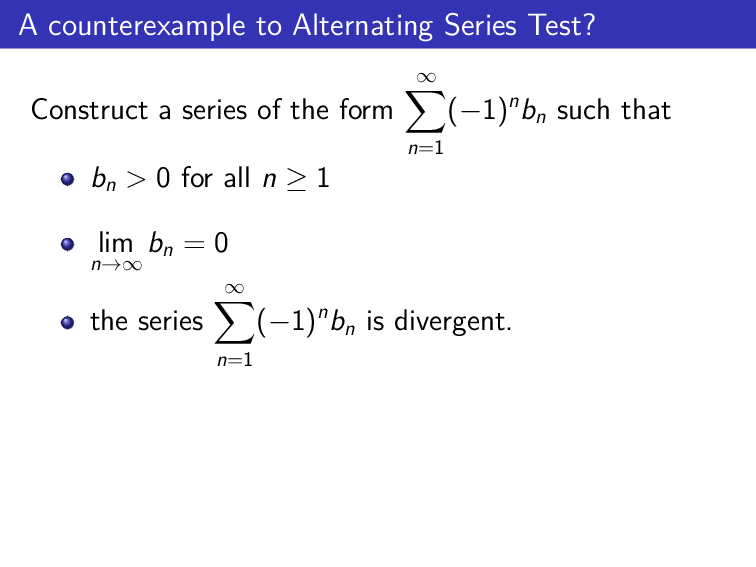
A counterexample to the alternating series test?
A counterexample to Alternating Series Test?
Warning. This is one of those activities that looks confusing, makes students react with “I do not know”, and tempts them to just wait for your answer while doing nothing. Unless you have enough time and a class that is willing to engage in collaboration, this activity is not worth it.
-
Small hint: there can’t be a counterexample to the Alternating Series Test, so which of the hypotheses is this series failing?
Many students realize that we need not to be eventually decreasing. Unfortunately, this by itself is not enough and most students get stuck.
-
Big hint: You can define and independently.
Students will figure it out with this hint, but unfortunately, it gives a little bit too much away. It would be better to guide to discover this hint themselves, but I do not know how.
-
Sample answer: and .
Related Videos
Absolute and conditional convergence
Absolutely convergent or conditionally convergent?
Absolutely convergent or conditionally convergent?
-
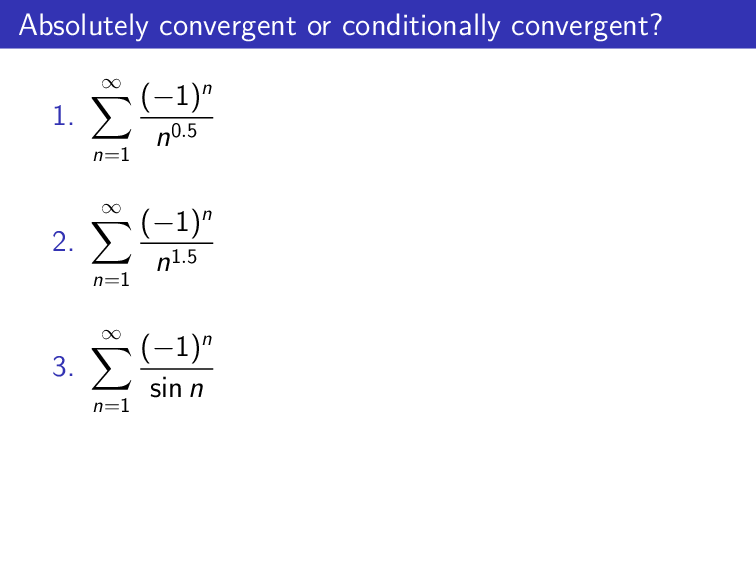
Quick check of the definition of absolute and conditional convergence. The examples are easy if we remember the definitions.
-
Answer:
-
is conditionally convergent
-
is absolutely convergent
-
is divergent. (Yes, the wording is misleading on purpose, just to check if they are paying attention.)
-
True or False - Absolute Values
True or False - Absolute Values
-
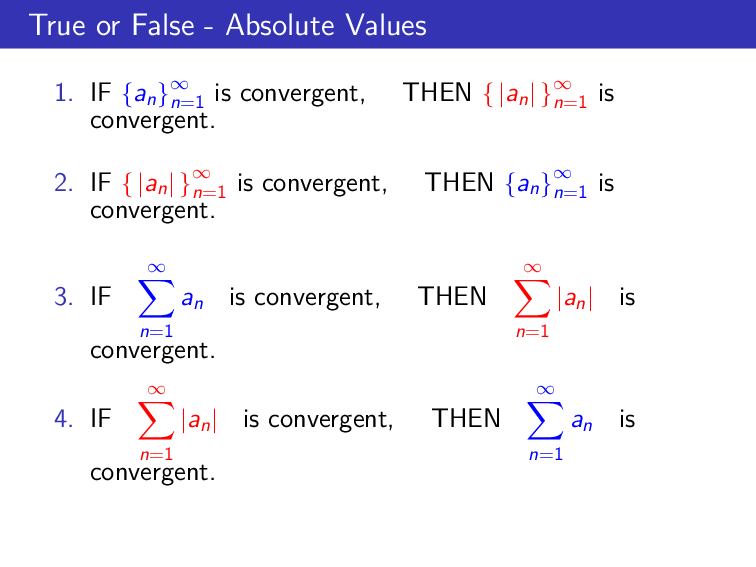
Questions 3 and 4 are the “absolute convergence test”. This is an essential result that students must know.
-
Questions 1 and 2, by contrast, are new questions. Students must think of them on the spot. Having all four questions together will confuse some of them.
-
Answers: 1 and 4 are true; 2 and 3 are false.
Positive and negative terms
Positive and negative terms - 1
Positive and negative terms - 2
-
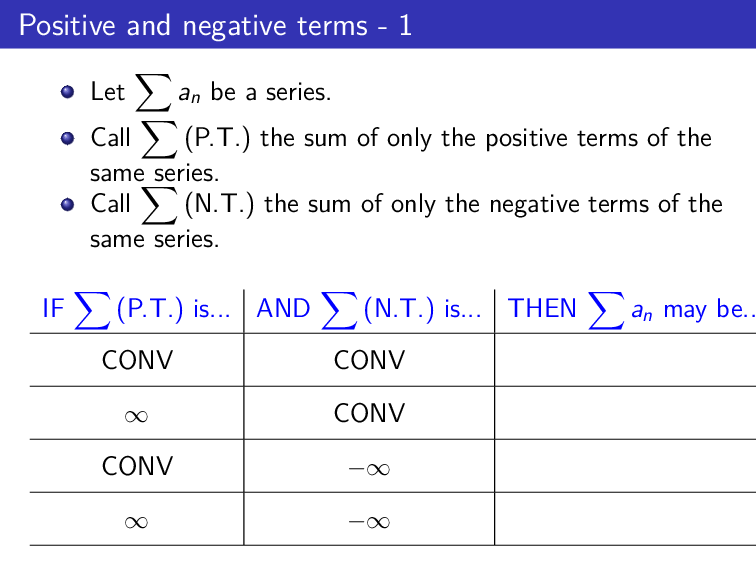
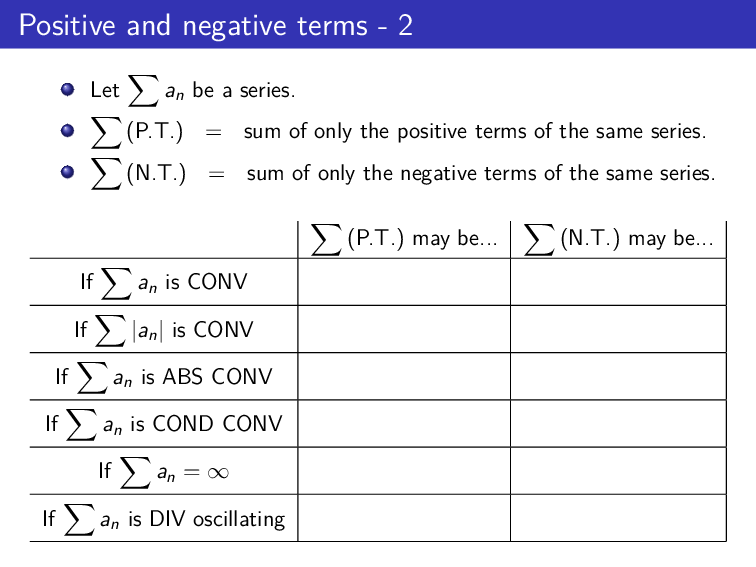
These two activities work fine together or independently (either one of them).
-
The goal is to make students think about the ideas behind the absolute convergence test, and the difference between absolute and conditional convergence (including the reason for the name).
-
Answers:
may be convergent convergent, , , or oscillating may be may be convergent or convergent or convergent convergent convergent convergent convergent or
The Ratio Test
Quick review: convergence or divergent
Quick review: Convergent or divergent?
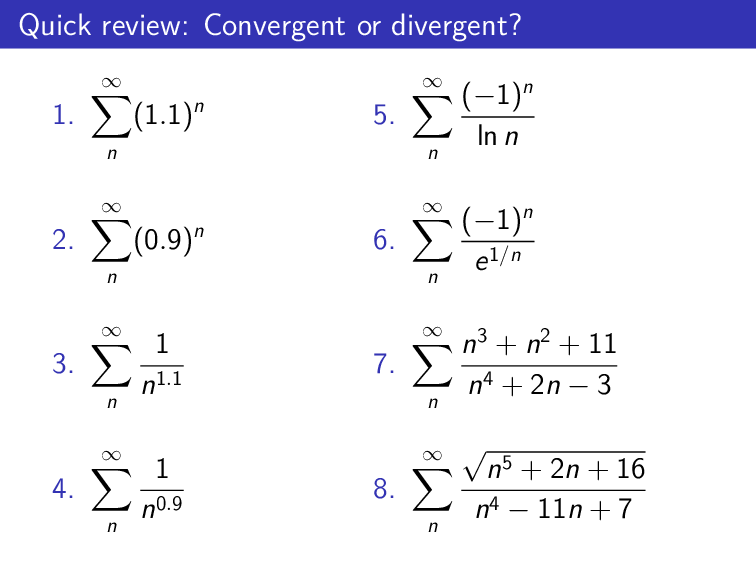
-
This activity works well as a warm up on the last session of Unit 13, before we go on practicing the Ratio Test.
-
This is NOT about the Ratio Test. Rather, it is a summary of all the important examples of series whose convergence is very easy to calculate. We want students to be able to answer these question in their sleep.
-
Answers:
- Divergent (geometric)
- Convergent (geometric)
- Convergent (-series)
- Divergent (-series)
- Convergent (alternating series test)
- Divergent (necessary condition)
- Divergent (LCT)
- Convergent (LCT)
Ratio test
Ratio Test: Convergent or divergent?
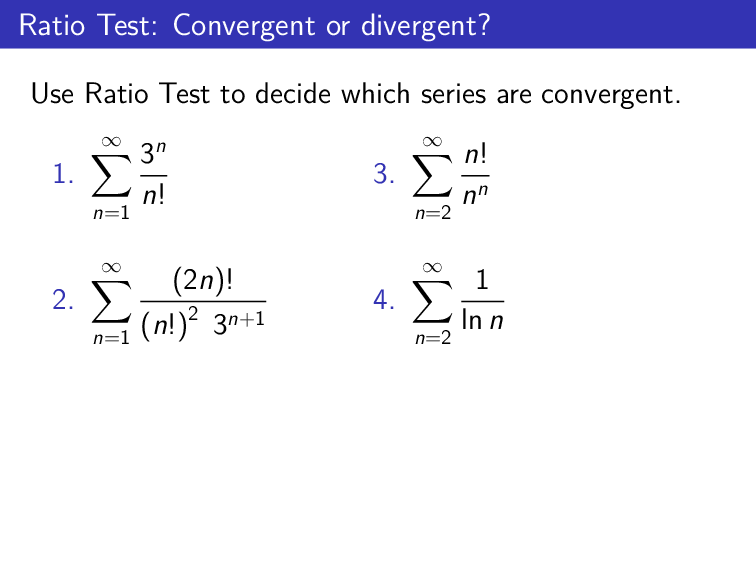
-
Standard practice with the Ratio Test.
-
What to expect:
-
Question 1 (convergent) is easy, but students are likely much slower than you expect.
-
In Question 2 (divergent), some students have trouble simplifying
-
In Question 3 (convergent), students will have trouble computing the limit.
-
In Question 4 (divergent) the Ratio Test is inconclusive. This is on purpose, to remind students this may happen. Use BCT instead.
-
Root test
Root test
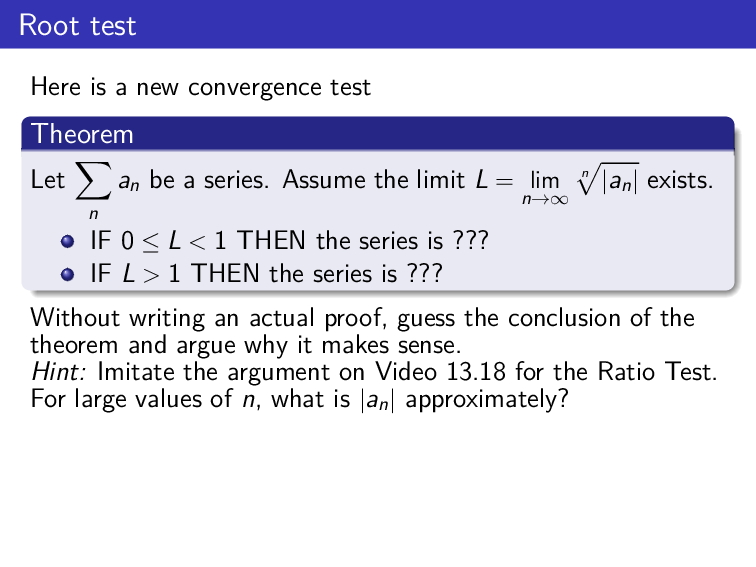
Warning. This is one of those activities that looks confusing, makes students react with “I do not know”, and tempts them to just wait for your answer while doing nothing. Unless you have enough time and a class that is willing to engage in collaboration, this activity is not worth it.
-
In Video 13.18 students learn the Ratio Test and a heuristic argument (not a formal proof) of why the theorem is true. The videos do not include the Root Test at all.
-
The goal of this question is to guide students to come up with a new theorem (intuitively; without necessarily writing a formal proof). It is a bit of a gamble: it may pay off and be very satisfying.... or it may flop and lead nowhere.
-
To clarify: students do not need to learn the Root Test in this course. In this activity they are practicing other skills; the goal is not to memorize the theorem itself.
The two slides work well together or individually (any of them).
Slide 1 is an example where students can compute a series from beginning to end using the definition.
Slide 2 reminds students that we cannot assume infinite sums behave like finite sums. Series are a new concept and properties cannot be taken for granted.
Answers:
Slide 1: Sk=21[1+21−k+11−k+21]
Slide 2: The series is divergent to −∞. The split we did as difference of two series was illegal, because it was “∞−∞”.